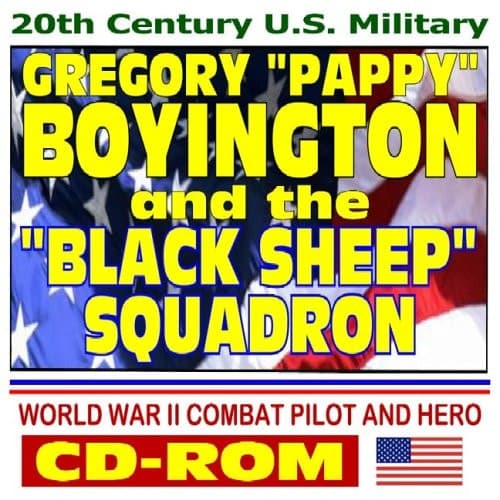
20th Century U.S. Military: Gregory "Pappy" Boyington and the "Black Sheep" Squadron, World War II Medal of Honor Winner and American Hero
U.S. GovernmentPublished2006
Pages15189
FormatCD-ROM
PublisherProgressive Management
Synopsis
This electronic book on CD-ROM presents the story of an American fighting hero, Marine Colonel "Pappy" Boyington and his “Black Sheep” squadron. Boyington is the greatest living ace in the Vought F4U Corsair and winner of the Medal of Honor. Born in Idaho in 1914, he was an ROTC cadet while in college and entered the Coastal Artillery as a second lieutenant soon after graduation. He transferred to the Marine Corps Reserve in 1935 and was released to inactive duty until 1936 when he accepted an appointment as an aviation cadet. Boyington completed flight training the following year and flew with the Marine Corps until August 1941 when he resigned his commission to join the American Volunteer Group (AVG) in China. While with the famed "Flying Tigers," he became a squadron commander, flew over 300 combat hours, and shot down six Japanese aircraft. The AVG disbanded in July 1942, and Boyington was soon reinstated as a major in the Marine Corps. In August 1943, he formed Fighter Squadron VMF-214 to fly Corsairs in the Pacific Theater. He manned his unit with misfits, leftouts, replacements, and "green" pilots, all of which contributed to the now famous name "Black Sheep Squadron." Called "Pappy" by his younger subordinates, Boyington quickly proved his skills as a commander and whipped his Black Sheep into a tough combat unit that destroyed 18 enemy aircraft on their first combat mission, which was over the Japanese-held island of Bougainville. On that mission, "Pappy" scored five aerial victories and, within just 32 days, shot down a total of 14 enemy planes. In January 1944, he was reported missing in action after leading his unit on a fighter sweep over heavily defended Rabaul. Although it was not known until the end of the war, Boyington had been shot down and taken prisoner. He remained a POW for 20 months until his release on 29 August 1945. After Boyington s return home, President Truman awarded him the Medal of Honor for heroic actions as commander of the Black Sheep Squadron. Colonel Boyington retired from the Marine Corps in 1947. This CD-ROM is packed with over 15,000 pages reproduced using Adobe Acrobat PDF software - allowing direct viewing on Windows and Macintosh systems. The Acrobat cataloging technology adds enormous value and uncommon functionality to this impressive collection of government documents and material. Our news and educational discs are privately compiled collections of official public domain U.S. government files and documents - they are not produced by the federal government. They are designed to provide a convenient user-friendly reference work, utilizing the benefits of the Adobe Acrobat format to uniformly present thousands of pages that can be rapidly reviewed, searched by finding specific words, or printed without untold hours of tedious research and downloading.
Recommendations
Playing with the Enemy A Baseball Prodigy, a World at War, and a Field of Broken Dreams
by Gary W. Moore
Like the Boyington account, Hillenbrand reconstructs an incredible true story of a military man tested beyond ordinary limits—but she does it with narrative momentum that reads like a thriller. You'll find the same meticulous attention to historical detail and the same portrait of someone who refused to break, just told through a lens that makes you feel the heat of the moment rather than reading it as a historical document.
View book
The Right Stuff
by Tom Wolfe
Wolfe captures that same breed of fearless aviator—test pilots instead of combat pilots—but with a wry, almost satirical eye that makes you laugh while you're marveling at their audacity. Where the Boyington book is straightforward documentation, Wolfe's prose style turns the space race into something mythic and absurd simultaneously, showing you how these men thought about risk and glory in ways that feel deeply human rather than heroic.
View book
The Killer Angels
by Michael Shaara
This is my gentle surprise for you—a Civil War novel, not WWII—but Shaara does something remarkable: he reconstructs the Battle of Gettysburg by getting inside the minds of the commanders on both sides, showing you how military leadership actually works under impossible pressure. If you appreciated how the Boyington book showed his skill at taking misfits and forging them into a unit, you'll find Shaara exploring that same question of command, but through the intimate thoughts of Lee and Meade as they make decisions that ripple across thousands of lives.
View book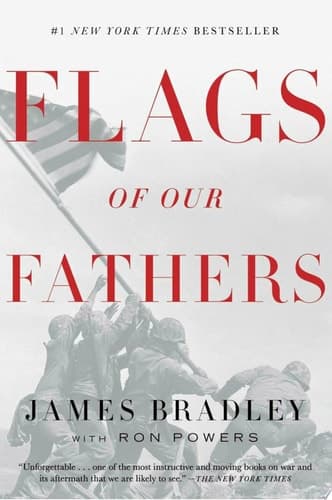
Flags of Our Fathers
by James Bradley
Bradley weaves together the personal stories of the men in that famous Iwo Jima photograph with the larger machinery of war and propaganda, creating something that honors the individual sacrifice while questioning the narratives we build around it. Like your Boyington book, it's deeply researched and grounded in primary sources, but Bradley adds layers of complexity about what it means to be called a hero and what happens when you come home.
View bookAbout U.S. Government
U
U.S. Government
Born 1776
In 1507, German cartographer Martin Waldseemüller produced a world map on which he named the lands of the Western Hemisphere "America" after Italian explorer and cartographer Amerigo Vespucci. The former British colonies first used the country's modern name in the Declaration of Independence, the "unanimous Declaration of the thirteen united States of America" adopted by the "Representatives of the united States of America" on July 4, 1776. The current name was finalized on November 15, 1777, when the Second Continental Congress adopted the Articles of Confederation, which states, "The Stile of this Confederacy shall be 'The United States of America.'" The short form the United States is also standard. Other common forms include the U.S., the USA, and America. Colloquial names include the U.S. of A. and the States. Columbia, a once popular name for the United States, was derived from Christopher Columbus. It appears in the name "District of Columbia".
View author page