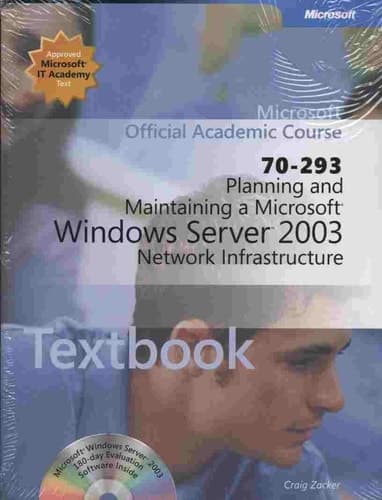
70-293 Planning and Maintaining a Microsoft Windows Server 2003 Network Infrastructure Package
Microsoft Official Academic CoursePublished2006
Pages615
Formatpaperback
PublisherWiley
Synopsis
Through lectures, discussions, demonstrations, textbooks exercises, and classroom labs, this Official Microsoft Learning product helps you teach your students the knowledge and skills necessary to install, configure, administer, and support the primary networking services in the Microsoft Windows Server 2003 operating system. In addition, this text provides students with the information required to pass Microsoft certification exam 70-293: Planning and Maintaining a Microsoft Windows Server 2003 Network Infrastructure as part of becoming a Microsoft Certified Professional (MCP) or a Microsoft Certified Systems Engineer (MCSE).
Recommendations
The Practice of System and Network Administration
by Thomas A. Limoncelli
You've just mastered the theoretical framework of Windows Server infrastructure, and Limoncelli takes that knowledge into the real world—he's written the manual for what actually happens when you're responsible for keeping systems running at 3 AM. His approach mirrors the MOAC's structured methodology but adds the pragmatic troubleshooting mindset that separates certification knowledge from genuine expertise.
View book
The Cuckoo's Egg Tracking a Spy Through the Maze of Computer Espionage
by Cliff Stoll
Here's your surprise pick: a true crime narrative about a Berkeley astronomer who becomes an accidental network detective tracking a hacker through the early internet. Stoll writes with the same methodical problem-solving approach you've been studying, but he's hunting an adversary through TCP/IP protocols and dial-up connections—it's a thriller that makes network infrastructure feel genuinely consequential because someone's actually trying to break in.
View book
TCP/IP Illustrated
by W. Richard Stevens
Stevens doesn't just explain how TCP/IP works; he shows you the actual packets moving across the wire, the way a master craftsman shows you the grain in the wood. Where your MOAC text covered Windows Server's implementation of these protocols, Stevens reveals the underlying architecture that makes everything you just learned actually function—it's the difference between knowing how to use a tool and understanding why it works.
View book
Stephen Hawking's A Brief History of Time A Reader's Companion
by Stephen Hawking
A genuine left-turn recommendation, but stay with me: Hawking's approach to explaining complex systems—breaking them into understandable components, building from fundamentals to mind-bending conclusions—is exactly the pedagogical method your MOAC textbook used. Plus, if you're planning infrastructure for the next decade, understanding how systems scale and interact at fundamental levels (even cosmological ones) sharpens your architectural thinking in unexpected ways.
View book
Designing Data-Intensive Web Applications
by Ceri, Stefano
You've learned to plan and maintain a network infrastructure from 2003; Kleppmann shows you where infrastructure is heading. He explores how modern systems handle data at scale—distributed databases, message queues, consensus algorithms—with the same clear, hands-on methodology you've just finished studying, but applied to the architectural challenges that define contemporary systems administration.
View bookAbout Microsoft Official Academic Course
Biography coming soon.
View author page