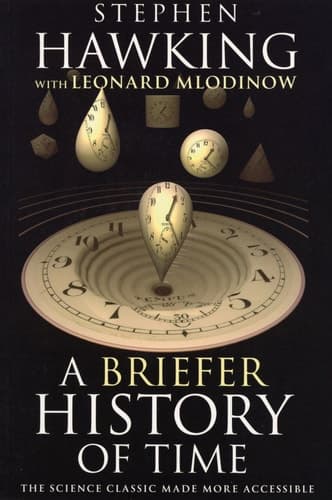
A Briefer History of Time The Science Classic Made More Accessible
Stephen HawkingPublished2008
Pages176
Formatpaperback
PublisherRandom House Publishing Group
Synopsis
#1 NEW YORK TIMES BESTSELLING AUTHORS
The science classic made more accessible
• More concise • Illustrated
FROM ONE OF THE MOST BRILLIANT MINDS OF OUR TIME COMES A BOOK THAT CLARIFIES HIS MOST IMPORTANT IDEAS
Stephen Hawking’s worldwide bestseller A Brief History of Time remains a landmark volume in scientific writing. But for years readers have asked for a more accessible formulation of its key concepts—the nature of space and time, the role of God in creation, and the history and future of the universe. A Briefer History of Time is Professor Hawking’s response.
Although “briefer,” this book is much more than a mere explanation of Hawking’s earlier work. A Briefer History of Time both clarifies and expands on the great subjects of the original, and records the latest developments in the field—from string theory to the search for a unified theory of all the forces of physics. Thirty-seven full-color illustrations enhance the text and make A Briefer History of Time an exhilarating and must-have addition in its own right to the great literature of science and ideas.
Recommendations
The Elegant Universe: Superstrings, Hidden Dimensions, and the Quest for the Ultimate Theory
by Brian Greene
Greene takes the string theory concepts Hawking mentions and builds an entire narrative around them, but he's got a gift for analogy that makes the genuinely weird physics feel almost intuitive. Where Hawking is precise and economical, Greene luxuriates in explaining why these ideas matter—he'll spend a chapter on why we should care about extra dimensions before diving into the math.
View book
Gödel, Escher, Bach: An Eternal Golden Braid
by Douglas Hofstadter
This is the surprise pick, but hear me out: Hofstadter is obsessed with the same question Hawking circles around—how do complex systems emerge from simple rules?—except he explores it through music, art, and mathematics simultaneously. It's playful where Hawking is austere, and it'll make you think about consciousness and self-reference in ways that feel like a natural extension of thinking about time and the universe.
View book
The Structure of Scientific Revolutions
by Thomas S. Kuhn
Published in 1962, this older book asks a meta-question about the very enterprise Hawking is engaged in: how does scientific knowledge actually advance? Kuhn argues it's not a smooth accumulation but a series of paradigm shifts, which gives you a framework for understanding why Hawking had to write a *new* book updating his earlier one—the field genuinely transformed.
View book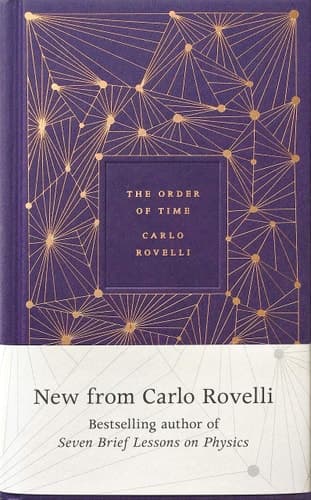
The Order of Time
by Carlo Rovelli
Rovelli is a theoretical physicist who writes like a poet, and he's genuinely obsessed with one of Hawking's central preoccupations: what *is* time, really? But where Hawking builds toward answers, Rovelli dismantles our intuitions about time piece by piece, leaving you in productive confusion. It's shorter and more meditative than Hawking, almost philosophical in its approach to a physics question.
View book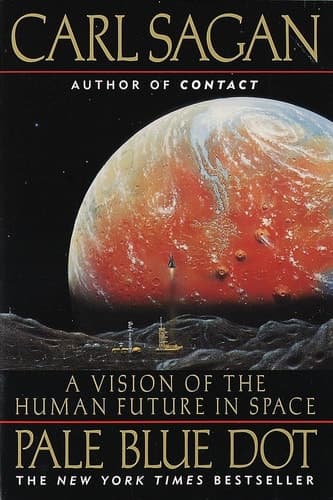
Pale Blue Dot A Vision of the Human Future in Space
by Carl Sagan
Sagan takes the cosmic perspective Hawking establishes and asks what it means for *us*—how does understanding our place in the universe change how we should live? It's got the same clarity and wonder as Hawking, but Sagan is more interested in the emotional and philosophical weight of these discoveries, and he's a masterful storyteller who makes you feel the scale of things rather than just understand it.
View bookAbout Stephen Hawking
Biography coming soon.
View author page