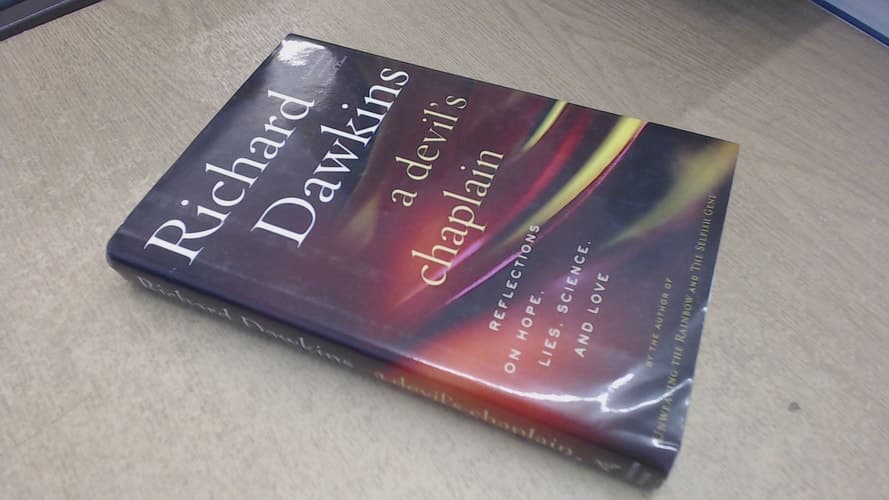
A Devil's Chaplain Reflections on Hope, Lies, Science, and Love
Richard DawkinsPublished2003
Pages263
Formathardcover
PublisherHoughton Mifflin Company
Synopsis
One of the most renowned evolutionary biologists at work today, Richard Dawkins has written passionately for years on subjects that matter deeply to him - and matter urgently to all of us. A Devil's Chaplain brings together the best and most provocative of his essays, on subjects ranging from evolution to ethics, from travel to literature, from education to religion. The result is an intriguing portrait of one of the finest minds in science.
With eloquence and vigor, these essays put forward Dawkins's most fundamental axiom: seek truth. He speaks out against pseudoscience and deftly dissects religion and mysticism. In a powerful letter to his ten-year-old daughter, he argues for the necessity of basing any belief on solid evidence. And he doesn't shy away from skewering the loftiest institutions, whether judicial or educational. "To hell with . . . your fact-stuffed syllabuses and your endless roster of exams," he proclaims with refreshing directness. He writes infectiously of his awe at the marvelous complexity of the universe, pays moving tribute to dear friends and worthy colleagues, and tenderly recalls his boyhood in Africa. Uncompromising, even ruthless as Dawkins famously is when defending scientific truth and reason, this collection also shows a gentler, more contemplative side which may surprise his many readers.
Here we meet the essential Richard Dawkins: inspirational in both his unswerving attention to rationalism and his abiding passions.
Recommendations
Generating recommendations…
Our AI is preparing recommendations for A Devil's Chaplain Reflections on Hope, Lies, Science, and Love. This usually takes under a minute.
About Richard Dawkins
R
Richard Dawkins
Born 1941
Clinton Richard Dawkins, FRS, FRSL is a British ethologist, evolutionary biologist and popular science author. He was formerly Professor for Public Understanding of Science at Oxford and was a fellow of New College, Oxford. Dawkins came to prominence with his 1976 book *The Selfish Gene*, which popularised the gene-centred view of evolution and introduced the term meme. In 1982, he made a widely cited contribution to evolutionary biology with the concept, presented in his book *The Extended Phenotype*, that the phenotypic effects of a gene are not necessarily limited to an organism's body, but can stretch far into the environment, including the bodies of other organisms. Dawkins is well known for his candid criticism of creationism and intelligent design. In his 1986 book *The Blind Watchmaker*, he argued against the watchmaker analogy, an argument for the existence of a supernatural creator based upon the complexity of living organisms. Instead, he described evolutionary processes as analogous to a blind watchmaker. He has since written several popular science books, and makes regular television and radio appearances, predominantly discussing these topics. ([Source][1]) [1]: http://en.wikipedia.org/wiki/Richard_Dawkins
View author page