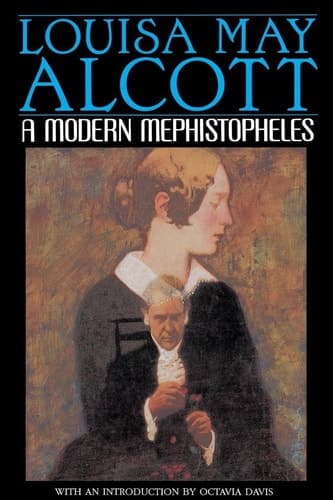
A Modern Mephistopheles: A Novel
Louisa May AlcottPublished1995
Pages240
Formatpaperback
PublisherBantam
Synopsis
Although beloved for her children’s classic Little Women, Louisa May Alcott had a passion for sensational literature that she only dared issue anonymously or under a pseudonym. Her favorite among these adult fictions, A Modern Mephistopheles was first published in 1877 and has been rediscovered and published under Alcott’s name.
This chilling tale of lust, deception, and greed beings on a midwinter night as Felix Canaris, a despairing writer about to take his own life, is saved by a knock at the door. His mysterious visitor, Jasper Helwyze, promises the poor student fame and fortune in return for his complete devotion. The embittered Helwyze then plots to corrupt his overly ambitious protégé by artfully manipulating the innocent and beautiful Gladys. When Helwyze decides that he wants Gladys for himself, Felix must defend the adoring young woman from the corrosive influence of his diabolical patron.
A novel of psychological complexity that touches on controversial subjects such as sexuality and drug use, A Modern Mephistopheles is a penetrating and powerful study of human evil and its appalling consequences.
Recommendations
Generating recommendations…
Our AI is preparing recommendations for A Modern Mephistopheles: A Novel. This usually takes under a minute.
About Louisa May Alcott
L
Louisa May Alcott
1832–1888
Louisa May Alcott was born in Germantown, Pennsylvania on November 29, 1832. She and her three sisters, Anna, Elizabeth, and May, were educated by their father, philosopher and teacher Bronson Alcott, and raised on the practical Christianity of their mother, Abigail May. Louisa spent her childhood in Boston and in Concord, Massachusetts, where her days were enlightened by visits to Ralph Waldo Emerson’s library, excursions into nature with Henry David Thoreau, and theatricals in the barn at "Hillside". Like her character, "Jo March" in Little Women, young Louisa was a tomboy. "No boy could be my friend till I had beaten him in a race," she claimed, "and no girl if she refused to climb trees, leap fences ..." For Louisa, writing was an early passion. She had a rich imagination and often her stories became melodramas that she and her sisters would act out for friends. Louisa preferred to play the "lurid" parts in these plays --"the villains, ghosts, bandits, and disdainful queens." At age 15, troubled by the poverty that plagued her family, she vowed: "I will do something by and by. Don’t care what, teach, sew, act, write -- anything to help the family; and I’ll be rich and famous and happy before I die, see if I won’t!"
View author page