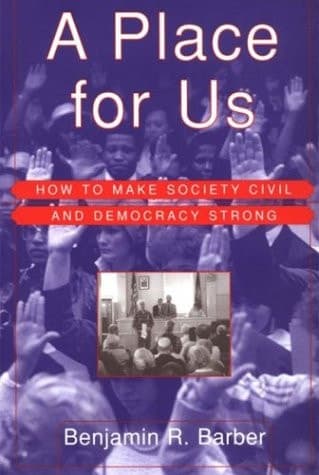
A Place for Us How to Make Society Civil and Democracy Strong
Benjamin R. BarberPublished1998
Pages172
Formathardcover
PublisherFarrar, Straus and Giroux
Synopsis
In our crowded, noisy world—too many people, too much crime, too many wars, not enough time—it seems almost impossible to locate and preserve the common ground where a civil society might flourish. Whatever happened to the civic virtue and community life that nourished true democracy?
In this provocative, hard-hitting book, political scientist Benjamin Barber tackles these questions head-on and, in answering them, retrieves the ideals of “civil society” from the nostalgists who want to re-create old-fashioned (and discriminatory) small communities and from the free-marketeers who associate it with unfettered commercial activity. Commentators have been making a fashion of civil society, but they tend to mean many different things by the phrase: this bracingly clear book shows how diverse the various notions are and how best to think about them.
Barber proposes practical strategies for making civil society real, for civilizing public discourse and promoting civic debate, and for affirming values beyond those of work and leisure, commerce and bureaucracy.
Recommendations
Generating recommendations…
Our AI is preparing recommendations for A Place for Us How to Make Society Civil and Democracy Strong. This usually takes under a minute.
About Benjamin R. Barber
B
Benjamin R. Barber
1939–2017
Benjamin R. Barber (August 2, 1939 – April 24, 2017) was an American political theorist and author, perhaps best known for his 1995 bestseller, *Jihad vs. McWorld*, and for 2013's *If Mayors Ruled the World* as well as the classic of democratic theory, 1984's *Strong Democracy* (revised in 2004). He became a top-level international consultant on participatory democracy as well as an adviser to Bill Clinton and Howard Dean. **Source**: <a href="https://en.wikipedia.org/wiki/Benjamin_Barber">Benjamin Barber</a> on Wikipedia (Wikipedia contributors, <a href="https://en.wikipedia.org/wiki/Wikipedia:Text_of_Creative_Commons_Attribution-ShareAlike_3.0_Unported_License">CC BY-SA 3.0</a>).
View author page