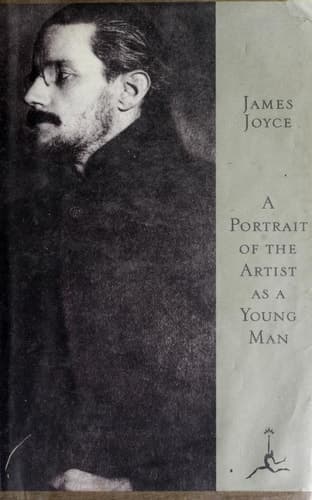
A Portrait of the Artist as a Young Man
James JoycePublished1996
Pages347
Formathardcover
PublisherModern Library
Synopsis
"Joyce dissolved mechanism in literature as effectively as Einstein destroyed it in physics," wrote Alfred Kazin. "He showed that the material of fiction could rest upon as tense a distribution and as delicate a balance of its parts as any poem. Joyce's passion for form, in fact, is the secret of his progress as a novelist. He sought to bring the largest possible quantity of human life under the discipline of the observing mind, and the mark of his success is that he gave an epic form to what remains invisible to most novelists...Joyce means many things to different people; for me his importance has always been primarily a moral one. He was perhaps, the last man in Europe who wrote as if art were worth a human life...By living for his art he may yet have given others a belief in art worth living for."
Recommendations
Generating recommendations…
Our AI is preparing recommendations for A Portrait of the Artist as a Young Man. This usually takes under a minute.
About James Joyce
J
James Joyce
1882–1941
James Augustine Aloysius Joyce was an Irish novelist and poet. He contributed to the modernist avant-garde and is regarded as one of the most influential and important authors of the 20th century. Joyce is best known for Ulysses (1922), a landmark work in which the episodes of Homer's Odyssey are paralleled in an array of contrasting literary styles, perhaps most prominent among these the stream of consciousness technique he utilised. Other well-known works are the short-story collection Dubliners (1914), and the novels A Portrait of the Artist as a Young Man (1916) and Finnegans Wake (1939). His other writings include three books of poetry, a play, occasional journalism and his published letters. [(Wikipedia][1]) [1]: https://en.wikipedia.org/wiki/James_Joyce
View author page