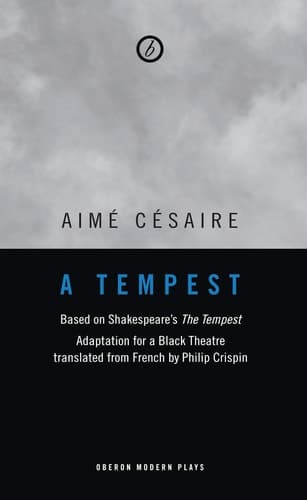
Synopsis
A Tempest is Aimé Césaire's anti-colonialist refashioning of Shakespeare. Alongside The Tragedy of King Cristophe and A Season in the Congo, it completes a 'triptych' of plays that examine the effects of colonialism. This translation premiered at The Gate Theatre, London.
Aimé Césaire has combined a political career as Martinican statesman with poetic calling in which he has been hailed as the leading Francophone poet of the twentieth century. Anti-colonialist visionary and prophet of negritude, his influence has been considerable in shaping ongoing post-colonial debate. Philip Crispin taught in Kingston, Jamaica, and spent four years in Paris studying, teaching and pursuing theatrical projects. He was literary manager of the Gate Theatre, before devoting himself to theatrical research.
Recommendations
The Tragedy of King Richard the Second With New Dramatic Criticism and an Updated Bibliography
by William Shakespeare
I know you've just finished A Tempest, but since you've clearly connected with Césaire's particular genius for reframing history through theatrical language, this completes that triptych he wrote and gives you the full arc of his anti-colonial vision. Where A Tempest interrogates Shakespeare's power dynamics, King Christophe examines the Haitian Revolution's aftermath—Césaire writing about a Black leader grappling with the weight of liberation itself, which deepens everything you've just experienced.
View book
The Maids.
by Jean Genet
Genet does what Césaire does—he takes a domestic scenario and transforms it into a hall of mirrors about power, servitude, and performance—but he approaches it from the opposite angle, watching two maids enact their own liberation through ritualized role-play. The claustrophobia and the way language becomes a weapon of resistance will feel familiar, though Genet's theatrical world is far more hallucinatory and deliberately artificial.
View book
Things Fall Apart, Chinua Achebe
by Chinua Achebe
Where Césaire rewrites a European canonical text to expose its colonial assumptions, Achebe writes the story colonialism tried to erase—the Igbo society before European arrival, told from inside with full complexity and dignity. It's the companion piece to A Tempest in a way: both authors insisting that colonized peoples have their own narratives that don't need Shakespeare's framework to be profound, though Achebe's novel form gives you a different kind of intimacy with that resistance.
View book
The Savage Detectives A Novel
by Roberto Bolaño
This is my surprise recommendation—a sprawling, formally experimental novel from the 1990s that shares Césaire's conviction that language itself can be a site of revolution. Two young poets in Mexico City pursue a mysterious literary movement, and what unfolds is a meditation on how marginal voices create meaning in systems designed to ignore them. It's not overtly political like A Tempest, but the DNA is there: the belief that how you tell a story *is* the politics.
View book
The Love of Three Oranges A Play for the Theatre That Takes the Commedia Dell'Arte of Carlo Gozzi and Updates It for the New Millennium
by Hillary DePiano
Walker's work operates in that same space where Césaire lives—using theatrical and visual language to interrogate how history gets told and who gets to tell it. Though this is more visual art/performance piece than traditional play text, it shares A Tempest's conviction that you can't separate aesthetics from politics, and that reframing historical trauma through artistic form is itself an act of reclamation. It's a different medium, but the intellectual and emotional work feels kindred.
View bookAbout Aimé Césaire
Biography coming soon.
View author page