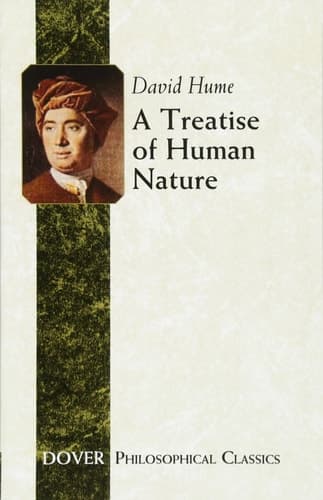
A Treatise of Human Nature
David HumePublished2003
Pages455
Formatpaperback
PublisherCourier Corporation
Synopsis
Unpopular in its day, David Hume's sprawling, three-volume 'A Treatise of Human Nature' (1739-40) has withstood the test of time and had enormous impact on subsequent philosophical thought. Hume's comprehensive effort to form an observationally grounded study of human nature employs John Locke's empiric principles to construct a theory of knowledge from which to evaluate metaphysical ideas. A key to modern studies of eighteenth-century Western philosophy, the Treatise considers numerous classic philosophical issues, including causation, existence, freedom and necessity, and morality. Unabridged republication of the edition originally published by Oxford at the Clarendon Press, London, 1888.
Recommendations
Generating recommendations…
Our AI is preparing recommendations for A Treatise of Human Nature. This usually takes under a minute.
About David Hume
D
David Hume
1711–1776
David Hume (7 May 1711 [26 April O.S.] – 25 August 1776) was a Scottish philosopher, historian, economist, and essayist, known especially for his philosophical empiricism and skepticism. He is regarded as one of the most important figures in the history of Western philosophy and the Scottish Enlightenment. Hume is often grouped with John Locke, George Berkeley, and a handful of others as a British Empiricist. Source: [English Wikipedia][1] [1]: http://en.wikipedia.org/wiki/David_Hume
View author page