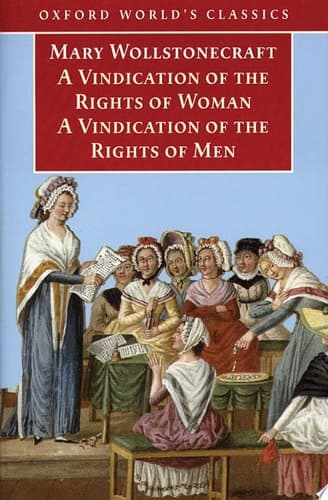
A Vindication of the Rights of Men; A Vindication of the Rights of Woman; An Historical and Moral View of the French Revolution
Mary WollstonecraftPublished1999
Pages413
Formatpaperback
PublisherOUP Oxford
Synopsis
This volume brings together the major political writings of Mary Wollstonecraft in the order in which they appeared in the revolutionary 1790s. It traces her passionate and indignant response to the excitement of the early days of the French Revolution and then her uneasiness at its later bloody phase. It reveals her developing understanding of women's involvement in the political and social life of the nation and her growing awareness of the relationship between politics and economics and between political institutions and the individual. In personal terms, the works show her struggling with a belief in the perfectibility of human nature through rational education, a doctrine that became weaker under the onslaught of her own miserable experience and the revolutionary massacres. Janet Todd's introduction illuminates the progress of Wollstonecraft's thought, showing that a reading of all three works allows her to emerge as a more substantial political writer than a study of The Rights of Woman alone can reveal.
Recommendations
Generating recommendations…
Our AI is preparing recommendations for A Vindication of the Rights of Men; A Vindication of the Rights of Woman; An Historical and Moral View of the French Revolution. This usually takes under a minute.
About Mary Wollstonecraft
M
Mary Wollstonecraft
1759–1797
Mary Wollstonecraft (pronounced /ˈwʊlstən.krɑːft/; 27 April 1759 – 10 September 1797) was an eighteenth-century British writer, philosopher, and advocate of women's rights. During her brief career, she wrote novels, treatises, a travel narrative, a history of the French Revolution, a conduct book, and a children's book. Wollstonecraft is best known for *A Vindication of the Rights of Woman* (1792), in which she argues that women are not naturally inferior to men, but appear to be only because they lack education. She suggests that both men and women should be treated as rational beings and imagines a social order founded on reason.
View author page