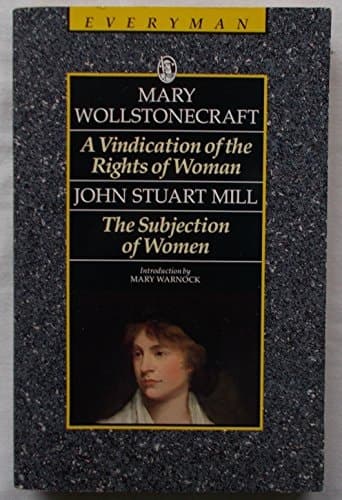
A Vindication of the Rights of Woman
Mary WollstonecraftPublished1986
Pages317
Formatpaperback
PublisherDent
Synopsis
After considering the historic page, and viewing the living world with anxious solicitude, the most melancholy emotions of sorrowful indignation have depressed my spirits, and I have sighed when obliged to confess, that either nature has made a great difference between man and man, or that the civilization which has hitherto taken place in the world has been very partial. I have turned over various books written on the subject of education, and patiently observed the conduct of parents and the management of schools; but what has been the result?- a profound conviction that the neglected education of my fellow-creatures is the grand source of the misery I deplore; and that women, in particular, are rendered weak and wretched by a variety of concurring causes, originating from one hasty conclusion. The conduct and manners of women, in fact, evidently prove that their minds are not in a healthy state; for, like the flowers which are planted in too rich a soil, strength and usefulness are sacrificed to beauty; and the flaunting leaves, after having pleased a fastidious eye, fade, disregarded on the stalk, long before the season when they ought to have arrived at maturity.- One cause of this barren blooming I attribute to a false system of education, gathered from the books written on this subject by men who, considering females rather as women than human creatures, have been more anxious to make them alluring mistresses than affectionate wives and rational mothers; and the understanding of the sex has been so bubbled by this specious homage, that the civilized women of the present century, with a few exceptions, are only anxious to inspire love, when they ought to cherish a nobler ambition, and by their abilities and virtues exact respect.
Recommendations
Generating recommendations…
Our AI is preparing recommendations for A Vindication of the Rights of Woman. This usually takes under a minute.
About Mary Wollstonecraft
M
Mary Wollstonecraft
1759–1797
Mary Wollstonecraft (pronounced /ˈwʊlstən.krɑːft/; 27 April 1759 – 10 September 1797) was an eighteenth-century British writer, philosopher, and advocate of women's rights. During her brief career, she wrote novels, treatises, a travel narrative, a history of the French Revolution, a conduct book, and a children's book. Wollstonecraft is best known for *A Vindication of the Rights of Woman* (1792), in which she argues that women are not naturally inferior to men, but appear to be only because they lack education. She suggests that both men and women should be treated as rational beings and imagines a social order founded on reason.
View author page