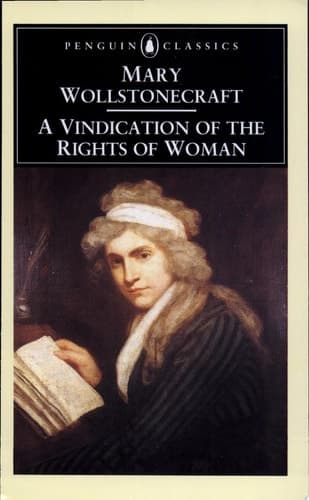
A Vindication of the Rights of Woman
Mary WollstonecraftPublished1992
Pages331
Formatpaperback
PublisherPenguin
Synopsis
First published in 1792, this book was written in a spirit of outrage and enthusiasm. In an age of ferment, following the American and French revolutions, Mary Wollstonecraft took prevailing egalitarian principles and dared to apply them to women. Her book is both a sustained argument for emancipation and an attack on a social and economic system. As Miriam Brody points out in her introduction, subsequent feminists tended to lose sight of her radical objectives. For Mary Wollstonecraft all aspects of women's existence were interrelated, and any effective reform depended on the redistribution of political and economic power.
Recommendations
Generating recommendations…
Our AI is preparing recommendations for A Vindication of the Rights of Woman. This usually takes under a minute.
About Mary Wollstonecraft
M
Mary Wollstonecraft
1759–1797
Mary Wollstonecraft (pronounced /ˈwʊlstən.krɑːft/; 27 April 1759 – 10 September 1797) was an eighteenth-century British writer, philosopher, and advocate of women's rights. During her brief career, she wrote novels, treatises, a travel narrative, a history of the French Revolution, a conduct book, and a children's book. Wollstonecraft is best known for *A Vindication of the Rights of Woman* (1792), in which she argues that women are not naturally inferior to men, but appear to be only because they lack education. She suggests that both men and women should be treated as rational beings and imagines a social order founded on reason.
View author page