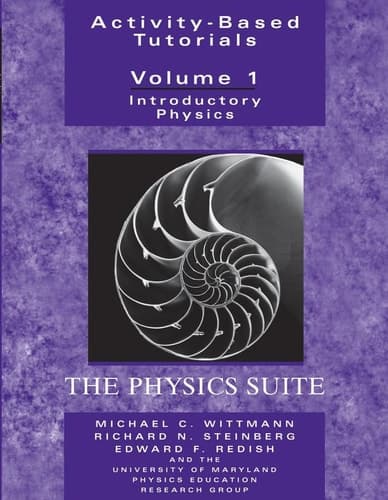
Activity-Based Tutorials Introductory Physics, The Physics Suite
Michael C. WittmannPublished2004
Pages126
Formatpaperback
PublisherWiley
Synopsis
The Activity-Based Tutorials are designed to accompany and enhance lecture instruction. They have been developed using a cycle of physics education research, including investigations into student learning on a given topic, development of materials, and revision of the materials based on evaluation after use in the classroom. Activity-Based Tutorials, Volume 1: Introductory Physics presents tutorials for topics in kinematics dynamics, oscillations, waves, heat and temperature, electrostatics, and circuits.
Recommendations
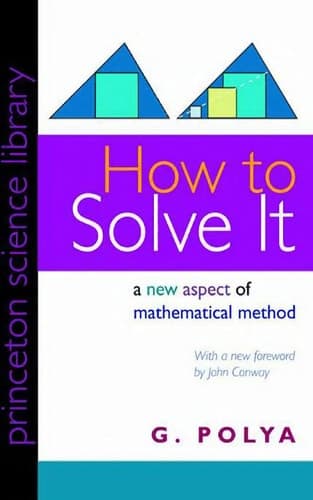
How to Solve It A New Aspect of Mathematical Method
by George Polya
Pólya's classic from 1945 shares Wittmann's conviction that learning happens through guided discovery rather than passive absorption. Where your tutorials walked you through physics problems by asking the right questions, Pólya does the same for mathematical problem-solving itself—he's essentially teaching you *how to think* about obstacles, which is the meta-skill underlying all those activities you just worked through.
View book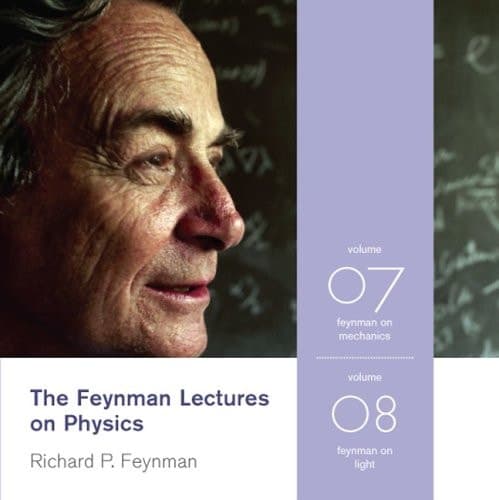
The Feynman Lectures on Physics Volumes 7-8
by Richard P. Feynman
Feynman's lectures (originally 1963-1965) operate on a completely different principle than Wittmann's tutorials, but they're complementary in an unexpected way: where Wittmann builds understanding through structured activities, Feynman builds it through relentless curiosity and making connections you wouldn't expect. Reading these after your tutorials is like seeing the same physics from the perspective of someone asking 'but *why* does that work?' at every turn.
View book
Seductress of Sight: Studies in Dutch Art of the Golden Age (Studies in Netherlandish Art and Cultural History)
by Eric Jan Sluijter
Mahajan teaches you how to strip physics problems down to their essence—to see the skeleton of a problem before you calculate anything. It's the perfect next step after your tutorials because it shows you how to *design* the kinds of simplified models that make those activities work in the first place, giving you insight into the pedagogical choices Wittmann made.
View book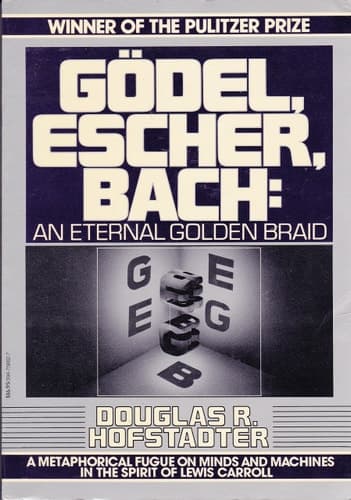
Gödel, Escher, Bach: An Eternal Golden Braid
by Douglas Hofstadter
Here's the surprise: Hofstadter's 1979 masterpiece isn't primarily about physics, but it's obsessed with the same thing your tutorials are—how patterns of information create meaning and understanding. He uses music, art, and mathematics to explore recursion and self-reference in ways that will make you see the structure of learning itself differently, including how those physics concepts you just mastered actually *connect* to each other.
View book
Thinking Past Terror Islamism and Critical Theory on the Left
by Susan Buck-Morss
Kahneman examines how humans actually learn and make decisions—which is precisely what Wittmann's research-based tutorials were designed around. After working through those activities, you'll find it fascinating to read about the cognitive science behind *why* active learning works, how your brain builds intuition about oscillations and circuits, and where our physical intuitions mislead us.
View bookAbout Michael C. Wittmann
Biography coming soon.
View author page