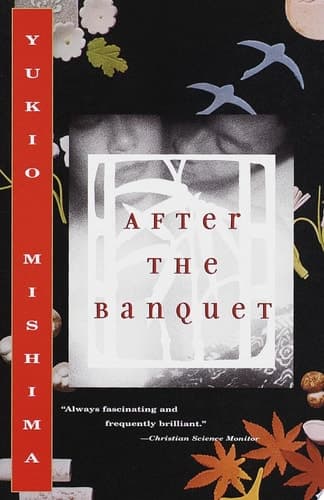
After the Banquet
Yukio MishimaPublished1999
Pages288
Formatpaperback
PublisherKnopf Doubleday Publishing Group
Synopsis
A portrait of a marriage in which lofty principles clash fatally with appetite and ambition—featuring a middle-aged restaurant owner who is "the biggest and the most profound thing Mishima has done so far in an already distinguished career" (The New Yorker).
“One of the outstanding writers of the world." —The New York Times
For years Kazu has run her fashionable restaurant with a combination of charm and shrewdness. But when the middle-aged entrepreneur falls in love with one of her clients, an aristocratic retired politician, she renounces her business in order to become his wife. In time, however, Kazu decides to resurrect her husband's political career. She embarks on a series of compromises and evasions that will force her to choose between her marriage and the demands of her irrepressible vitality.
Recommendations
Generating recommendations…
Our AI is preparing recommendations for After the Banquet. This usually takes under a minute.
About Yukio Mishima
Y
Yukio Mishima
1925–1970
Yukio Mishima (三島 由紀夫) was the pen name of Kimitake Hiraoka (平岡 公威), a Japanese author, poet and playwright, also remembered for his ritual suicide by seppuku. At age six, Mishima enrolled in elite Peers School (Gakushuin 学習院). At 12, Mishima began to write his first stories. He read voraciously the works of Oscar Wilde, Rainer Maria Rilke and numerous classic Japanese authors. After six years at school, he became the youngest member of the editorial board in its literary society. Mishima was attracted to the works of Tachihara Michizō, which in turn created an appreciation for the classical form of the waka. Mishima's first published works included waka poetry, before he turned his attention to prose. ([Source][1]) [1]: http://en.wikipedia.org/wiki/Yukio_Mishima
View author page