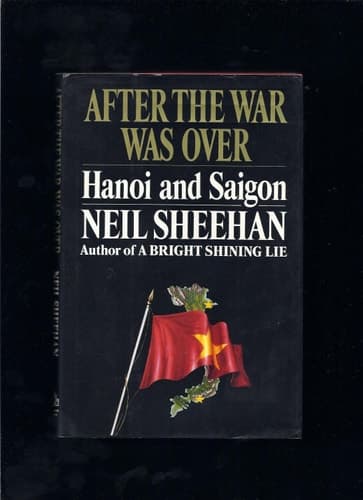
After the War was Over Hanoi and Saigon
Neil SheehanPublished1993
Pages131
Formatpaperback
PublisherVintage Books
Synopsis
"Neil Sheehan's A Bright Shining Lie won both the Pulitzer Prize and the National Book Award was praised by The New York Times Book Review as the "one book that captures the Vietnam war in the sheer Homeric scale of its passion and folly." Now Sheehan revisits the scene of his masterpiece, touring the war's battlefield, interviewing its survivors, and revealing the country that is just beginning to emerge from its ashes. Sheehan's Vietnam odyssey takes him from the melancholy time warp of Hanoi, with its rat-infested hotels and fearfully under-equipped hospitals, to the paradoxical prosperity of Ho Chi Minh City (once Saigon), where a former official of the Viet Cong has become her nation's most successful entrepreneur. He speaks with a "mother of martyrs' and an ARVN veteran of a Communist reeducation camp. He retells stories of loss and suffering, betrayal and reprisal, and adds to them his own reminiscences of the war he first observed 30 years ago. With After the War Was Over, that story is now complete, deeper, sadder, and more meaningful than anyone could have imagined" -- Back cover.
Recommendations
Generating recommendations…
Our AI is preparing recommendations for After the War was Over Hanoi and Saigon. This usually takes under a minute.
About Neil Sheehan
N
Neil Sheehan
Born 1936
Cornelius Mahoney "Neil" Sheehan (born October 27, 1936) is an American journalist. As a reporter for The New York Times in 1971, Sheehan obtained the classified Pentagon Papers from Daniel Ellsberg. His series of articles revealed a secret United States Department of Defense history of the Vietnam War and led to a US Supreme Court case, *New York Times Co. v. United States*, 403 U.S. 713 (1971), when the United States government failed to halt publication. He received a Pulitzer Prize and a National Book Award for his 1988 book *A Bright Shining Lie*, about the life of Lieutenant Colonel John Paul Vann and the United States involvement in the Vietnam War. **Source**: [Neil Sheehan](https://en.wikipedia.org/wiki/Neil_Sheehan) on Wikipedia.
View author page