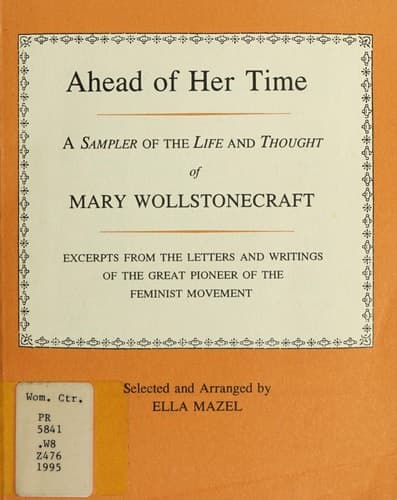
Ahead of Her Time: A Sampler of the Life and Thought of Mary Wollstonecraft
Mary WollstonecraftPublished1995
Pages117
Formatpaperback
PublisherRoutledge
Synopsis
Over two hundred years ago in England, this extraordinary young woman described herself as "the first of a new genus" - an unmarried female who supported herself by her own mental labors as writer, reviewer, and translator.
In 1792, she created a furor with A Vindication of the Rights of Woman, her impassioned plea for the liberation of her half of the human race. Nevertheless, in the repressive political climate of the period, the book was virtually buried along with its author, who died tragically five years later at the age of thirty-eight.
Today, however, Mary Wollstonecraft is universally acknowledged as the pioneer advocate of women's rights. But she was more than that. Her genius and breadth of vision enabled her to relate the status of women to human rights in general, to education, and to social justice.
In this selection of passages from her published letters and writings, the most cogent of her arguments and observations - on topics ranging from marriage and the frippery of dress and behavior to economic exploitation and political corruption - can be enjoyed and appreciated for the way she "speaks to us today across a gap of almost two centuries with a voice of courage and hope," as Eleanor Flexner wrote in a 1972 biography.
Recommendations
Generating recommendations…
Our AI is preparing recommendations for Ahead of Her Time: A Sampler of the Life and Thought of Mary Wollstonecraft. This usually takes under a minute.
About Mary Wollstonecraft
M
Mary Wollstonecraft
1759–1797
Mary Wollstonecraft (pronounced /ˈwʊlstən.krɑːft/; 27 April 1759 – 10 September 1797) was an eighteenth-century British writer, philosopher, and advocate of women's rights. During her brief career, she wrote novels, treatises, a travel narrative, a history of the French Revolution, a conduct book, and a children's book. Wollstonecraft is best known for *A Vindication of the Rights of Woman* (1792), in which she argues that women are not naturally inferior to men, but appear to be only because they lack education. She suggests that both men and women should be treated as rational beings and imagines a social order founded on reason.
View author page