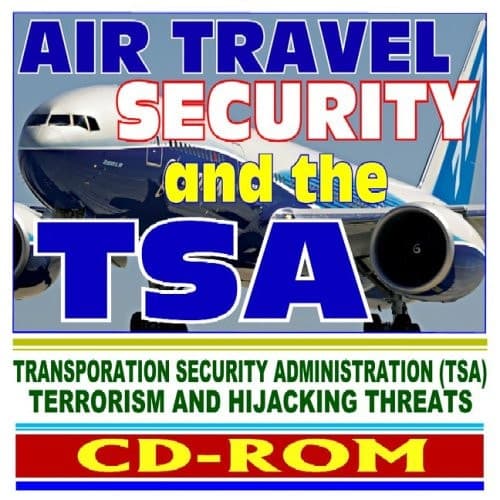
Air Travel Security and the Transportation Security Administration (TSA), Airport Screening, Bombs and Explosives, Terrorism and Hijacking, Traveler and Passenger Tips
U.S. GovernmentPublished2006
Pages31150
FormatCD-ROM
PublisherProgressive Management
Synopsis
This up-to-date electronic book on CD-ROM contains a collection of authoritative federal documents on the subject of air travel security and the Transportation Security Administration (TSA), with airport screening, bombs and explosives, airplane hijacking and terrorism threats, information for travelers and tourists, and passenger tips.
The Transportation Security Administration (TSA) was created in response to the terrorist attacks of September 11, 2001 as part of the Aviation and Transportation Security Act signed into law by President George W. Bush on November 19, 2001. TSA was originally in the Department of Transportation but was moved to the Department of Homeland Security in March 2003. TSAs mission is to protect the nations transportation systems by ensuring the freedom of movement for people and commerce. In February 2002, TSA assumed responsibility for security at the nations airports and by the end of the year had deployed a federal work force to meet challenging Congressional deadlines for screening all passengers and baggage.
TSA is committed to meeting its post-9/11 security mandate, while simultaneously providing the best possible customer service. The TSA Pledge to Travelers is a reminder to the public that in the pursuit of these goals, TSA remains in the service of the American people. The Transportation Security Administration (TSA) has launched the Registered Traveler pilot program in partnership with selected airlines and airports across the country.
Contents include: TSA Information for Travelers and Consumers, Employment, Business Opportunities, Industry Partners, Law and Policy, Security and Law Enforcement, TSA Screeners, TMSARM Vulnerability Self Assessment Tool, Explosives Detection Canine Teams, Claims for Missing and Damaged Items, Human Resources Policies and Directives, Aviation and Transportation Security Act (ATSA) which established the TSA, Transportation Security laws and regulations, congressional communications, information for industry partners including airport access control pilot program, maritime and land security grants, infrastructure fees, security technology deployment office (STDO), screener employment eligibility requirements, port security grants, risk management, career planning at TSA, national screening force opportunities, federal flight deck officers, travelers and consumers related to: air travel, passenger rail, passenger vessels, highway travel, mass transit, TSA partner programs, pers! ons with disabilities and medical conditions, TSA customer service, passenger resources, travel tips.
This incredible CD-ROM is packed with over 31,000 pages reproduced using Adobe Acrobat PDF software - allowing direct viewing on Windows and Macintosh systems. The Acrobat cataloging technology adds enormous value and uncommon functionality to this impressive collection of government documents and material.
Our news and educational discs are privately compiled collections of official public domain U.S. government files and documents - they are not produced by the federal government. They are designed to provide a convenient user-friendly reference work, utilizing the benefits of the Adobe Acrobat format to uniformly present thousands of pages that can be rapidly reviewed, searched by finding specific words, or printed without untold hours of tedious research and downloading. Vast archives of important public domain government information that might otherwise remain inaccessible are available for instant review no matter where you are. This book-on-a-disc format makes a great reference work and educational tool. There is no other reference that is as fast, convenient, comprehensive, thoroughly researched, and portable - everything you need to know, from the federal sources you trust.
Recommendations

The Logic Of Failure: Recognizing And Avoiding Error In Complex Situations
by Dietrich Dorner
You've just absorbed 31,000 pages of procedural documentation designed to prevent catastrophic failure—now read the cognitive science behind *why* those procedures matter. Dorner examines how intelligent people make terrible decisions in complex systems (like airport security networks), using real case studies that feel like detective work as he traces where human reasoning breaks down.
View book
The Shock Doctrine The Rise of Disaster Capitalism
by Naomi Klein
Klein traces how security crises—including post-9/11 policy—become opportunities for institutional restructuring and private profit. She writes with the investigative rigor of someone reading between government documents (much like you've been doing), but connects those dots to show the political and economic forces shaping agencies like the TSA that the official documents themselves won't explicitly discuss.
View book
Strangers Devour the Land: A Chronicle of the Assault upon the Last Coherent Hunting Culture in North America, the Cree Indians of Northern Quebec, and Their Vast Primeval
by Boyce Richardson
Here's your surprise pick: instead of more security policy, read ethnographic fieldwork about how ordinary Americans actually *experience* the security state and institutional change. Hochschild spends years embedded with real people navigating post-9/11 America, giving human texture to the bureaucratic frameworks you've been studying—she shows you who lives inside these systems.
View book
Thinking Past Terror Islamism and Critical Theory on the Left
by Susan Buck-Morss
TSA screening decisions, threat assessment, and security protocols all depend on human judgment under uncertainty—Kahneman's decades of behavioral economics research reveals exactly where and why those judgments systematically fail. You'll recognize the decision-making problems embedded in security procedures once you understand the cognitive biases he catalogs.
View book
The Sum of Things
by Olivia Manning
A genuinely unexpected angle: Currid-Halkett examines how status anxiety and conspicuous consumption shape modern life—including how TSA PreCheck and airline loyalty programs function as markers of class and privilege. It's sociological analysis of the very systems you've been reading about, but from the consumer behavior side rather than the security side.
View bookAbout U.S. Government
U
U.S. Government
Born 1776
In 1507, German cartographer Martin Waldseemüller produced a world map on which he named the lands of the Western Hemisphere "America" after Italian explorer and cartographer Amerigo Vespucci. The former British colonies first used the country's modern name in the Declaration of Independence, the "unanimous Declaration of the thirteen united States of America" adopted by the "Representatives of the united States of America" on July 4, 1776. The current name was finalized on November 15, 1777, when the Second Continental Congress adopted the Articles of Confederation, which states, "The Stile of this Confederacy shall be 'The United States of America.'" The short form the United States is also standard. Other common forms include the U.S., the USA, and America. Colloquial names include the U.S. of A. and the States. Columbia, a once popular name for the United States, was derived from Christopher Columbus. It appears in the name "District of Columbia".
View author page