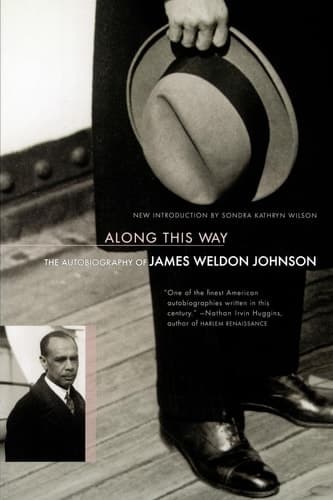
Along This Way The Autobiography of James Weldon Johnson
James Weldon JohnsonPublished2000
Pages440
Formatpaperback
PublisherHachette Books
Synopsis
Here is, to quote the eminent historian Nathan Irvin Huggins, “one of the finest American autobiographies written in this century.” Born in 1871 in Jacksonville, Florida, James Weldon Johnson began his career as a high-school principal. He went on to attain success as a songwriter on Broadway and as the compiler of the definitive Book of American Negro Spirituals. But he achieved one of his greatest triumphs in 1912, when, under a pseudonym, he published The Autobiography of an Ex-Colored Man—a classic novel about a musician who rejects his black roots, a novel that is still in print today in multiple paperback editions. Johnson went on to be, from 1920 to 1930, the first African-American head of the NAACP, fighting tirelessly for the passage of a federal anti-lynching law. His life story is that of a truly remarkable man who triumphed over a system of institutionalized racism to become one of black America's leading educators, men of letters, and reformers.
Recommendations
Generating recommendations…
Our AI is preparing recommendations for Along This Way The Autobiography of James Weldon Johnson. This usually takes under a minute.
About James Weldon Johnson
J
James Weldon Johnson
1873–1954
John Rosamond Johnson (August 11, 1873 – November 11, 1954; usually referred to as J. Rosamond Johnson)[1] was an American composer and singer during the Harlem Renaissance. Born in Jacksonville, Florida, he had much of his career in New York City. Johnson is noted as the composer of the tune for the hymn "Lift Every Voice and Sing". It was first performed live by 500 Black American students from the segregated Florida Baptist Academy, Jacksonville, Florida, in 1900.[2] The song was published by Joseph W. Stern & Co., Manhattan, New York (later the Edward B. Marks Music Company).[3] -Wikipedia
View author page