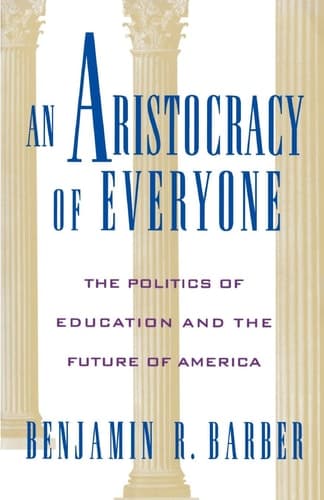
An Aristocracy of Everyone The Politics of Education and the Future of America
Benjamin R. BarberPublished1994
Pages307
Formatpaperback
PublisherOxford University Press
Synopsis
In a book that fundamentally alters the terms of the current debate over education in America, Barber argues that rather than pursuing a debate defined by controversy over who should be taught, what should be taught, and how it should be paid for, Americans must address education for what itis: the well-spring of democracy in the United States. With such an education young Americans will gain nothing less than an apprenticeship in liberty--one grounded in a renewed commitment to community service--an idea that Barber put into practice at Rutgers University, and one which PresidentClinton has enbraced as the key to a revitalized America. This approach will provide Americans the literacy to live in a civil society and the competence to participate in democratic communities, while promoting an educational excellence that will maintain America's economic, technical, andpolitical preeminence in a rapidly changing world.An Aristocracy of Everyone shows that education offers the only path toward rebuilding and reinvigorating the United States, and that this is a path we must begin to follow now.
Recommendations
Generating recommendations…
Our AI is preparing recommendations for An Aristocracy of Everyone The Politics of Education and the Future of America. This usually takes under a minute.
About Benjamin R. Barber
B
Benjamin R. Barber
1939–2017
Benjamin R. Barber (August 2, 1939 – April 24, 2017) was an American political theorist and author, perhaps best known for his 1995 bestseller, *Jihad vs. McWorld*, and for 2013's *If Mayors Ruled the World* as well as the classic of democratic theory, 1984's *Strong Democracy* (revised in 2004). He became a top-level international consultant on participatory democracy as well as an adviser to Bill Clinton and Howard Dean. **Source**: <a href="https://en.wikipedia.org/wiki/Benjamin_Barber">Benjamin Barber</a> on Wikipedia (Wikipedia contributors, <a href="https://en.wikipedia.org/wiki/Wikipedia:Text_of_Creative_Commons_Attribution-ShareAlike_3.0_Unported_License">CC BY-SA 3.0</a>).
View author page