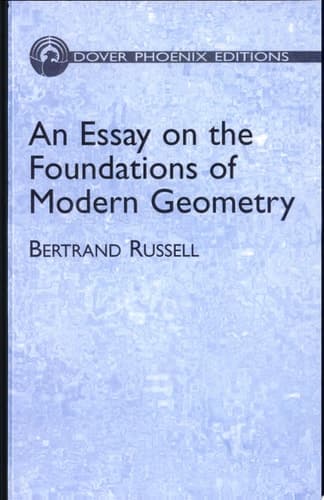
An Essay on the Foundations of Modern Geometry
Bertrand RussellPublished2003
Pages224
Formathardcover
PublisherCourier Corporation
Synopsis
Written by a Nobel laureate and one of the 20th century's most important logicians, this classic of science asks and answers a variety of basic questions about the intersection of philosophy and higher mathematics. Although Russell's conclusions are not the generally accepted modern solutions, his work offers exceptionally clear statements of important scientific problems and presents a logically coherent system. It is also a rich mine of insights, expressed with all of the author's usual clarity, precision, and elegantly reasoned analysis. This study is especially valuable for its coverage of the contributions of such thinkers as Kant, Lotse, Vaihinger, Herbart, Helmholtz, Erdmann, and Riemann. 1897 edition. 200 footnotes, mostly bibliographic.
Recommendations
Generating recommendations…
Our AI is preparing recommendations for An Essay on the Foundations of Modern Geometry. This usually takes under a minute.
About Bertrand Russell
B
Bertrand Russell
1872–1970
Bertrand Arthur William Russell (18 May 1872 – 2 February 1970) was a British philosopher, logician, mathematician, historian, and social critic.
View author page