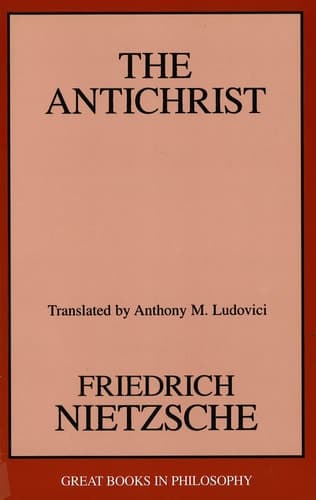
Antichrist
Friedrich Wilhelm NietzschePublished2000
Pages120
Formatpaperback
PublisherGlobe Pequot Publishing
Synopsis
A work of Nietzsche's later years, The Antichrist was written after Thus Spoke Zarathustra and shortly before the mental collapse that incapacitated him for the rest of his life. The work is both an unrestrained attack on Christianity and a further exposition of Nietzsche's will-to-power philosophy so dramatically presented in Zarathustra.Christianity, says Nietzsche, represents "everything weak, low, and botched; it has made an ideal out of antagonism towards all the self-preservative instincts of strong life." By contrast, Nietzsche defines good as: "All that enhances the feeling of power, the Will to Power, and power itself in man. What is bad? -- All that proceeds from weakness. What is happiness? -- The feeling that power is increasing, that resistance has been overcome."In attempting to redefine the basis of Western values by demolishing the formative influence of the Judeo-Christian tradition, The Antichrist has proved to be highly controversial and continuously stimulating to later generations of philosophers.
Recommendations
Generating recommendations…
Our AI is preparing recommendations for Antichrist. This usually takes under a minute.
About Friedrich Wilhelm Nietzsche
F
Friedrich Wilhelm Nietzsche
1917–1979
Giorgio Colli (1917 – 6 January 1979) was an Italian philosopher, philologist and historian. A native of Turin, taught ancient philosophy at Pisa's university for thirty years; he edited and translated Aristotle's *Organon and Kant's Critique of Pure Reason* for Einaudi, a major publishing house in Italy. Subsequently, he produced the first complete edition of Nietzsche's work (including all the posthumous fragments chronologically ordered) together with his friend Mazzino Montinari. His work culminated in *La Sapienza greca*, an edition and translation of the "Presocratics" (a term he rejected). Interrupted by his death in January 1979, it was supposed to be in eleven volumes. **Source**: [Giorgio Colli](https://en.wikipedia.org/wiki/Giorgio_Colli) on Wikipedia.
View author page