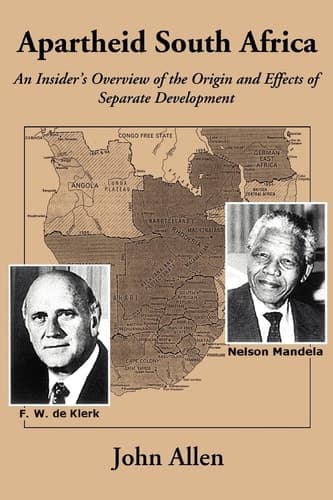
Apartheid South Africa An Insider's Overview of the Origin and Effects of Separate Development
John AllenPublished2005
Pages508
Formatpaperback
PublisheriUniverse
Synopsis
Although British-born, John Allen lived in South Africa from 1954 to 1990, a 36-year period during which the country experienced its most climactic--and sometimes terrible--events.
Speaking from firsthand knowledge and with an intimate understanding of the situation, the author takes us beyond the media hype that so dominated Western television screens to answer some of the most vital questions concerning the apartheid era:
• Who originated the system of government the world grew to hate so much? • Was South Africa the only 'apartheid' nation? • Did economic sanctions have the desired effect? • How did Washington's domestic agenda affect US foreign policy? • What was the West's real motive in forcing the country to its knees? • Why did Nelson Mandela's release from prison exacerbate rather than diminish violence? Apartheid South Africa addresses these and a host of other issues, bringing to light little-known facts concerning historical detail and providing the reader with eyewitness accounts of day-to-day life in one of the most dangerous countries in the world.
Recommendations
The Way of a Ship A Square-Rigger Voyage in the Last Days of Sail
by Derek Lundy
Waldmeir was a journalist embedded in South Africa during the final years of the regime, so she brings that same on-the-ground perspective you appreciated in Allen's account, but she focuses specifically on the negotiation period and the personalities driving change. Where Allen gives you the historical architecture of apartheid, Waldmeir shows you the human drama of its dismantling—the backroom conversations, the unexpected alliances, the moments when everything could have gone differently.
View book
A Man of the People
by Chinua Achebe
This is my surprise pick for you—a novel rather than history, but Achebe's satirical take on post-colonial African politics will deepen your understanding of the broader context Allen touches on. Published in 1966, it captures the corruption and power struggles that plagued newly independent African nations, giving you a literary window into why the continent's political trajectories diverged so dramatically. It's sharp, darkly funny, and surprisingly relevant to understanding South Africa's own post-apartheid challenges.
View book
Alan Paton's Cry, the Beloved Country
by Rose Kam
I know this seems like the obvious choice, but hear me out—Paton wrote this in 1948, just as apartheid was being formally codified, and reading it after Allen's insider account gives you something special: you see the moral landscape that existed *before* the system calcified, and you understand what was being destroyed. Allen's analytical framework will make you read Paton's characters not as tragic archetypes but as real people caught in a machinery that was just being built around them.
View book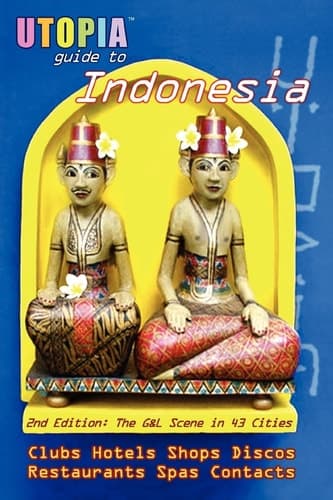
Utopia Guide to Indonesia (2nd Edition) The Gay and Lesbian Scene in 43 Cities Including Jakarta and the Island of Bali
by John Goss
Allen raises the question of Western motives in forcing South Africa's transformation, and Prashad's meticulously researched book answers it by showing you the pattern—how the U.S. and its allies have repeatedly intervened in foreign governments across decades and continents. This gives you the geopolitical context that Allen hints at but doesn't fully explore, and it's written with the same skepticism toward official narratives that makes Allen's account so refreshing.
View bookAbout John Allen
J
John Allen
Born 1941
John L. Allen is a former chairman of the Department of Geography and emeritus professor of geography at the University of Wyoming in Laramie. His publications, numbering more than thirty titles to date, reflect his broadly varied interests, including the exploration of the American West, human impacts on natural environments and related landscape changes, and images of the West. Among students of the Lewis and Clark expedition, Professor Allen’s best-known work is Lewis and Clark and the Image of the American Northwest (reprint, New York: Dover, 1975). Originally published under the title Passage through the Garden: Lewis and Clark and the Image of the American Northwest, it remains among the most authoritative and frequently-referenced works in the literature.-Discover Lewis&Clark
View author page