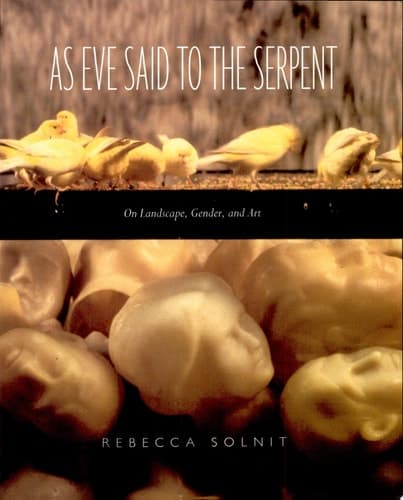
As Eve Said to the Serpent On Landscape, Gender, and Art
Rebecca SolnitPublished2001
Pages234
Formatpaperback
PublisherUniversity of Georgia Press
Synopsis
A multidisciplinary compilation of nineteen incisive essays ranges from the formality of traditional art criticism to intimate, lyrical meditations as they explore nuclear test sites, the meaning of national borders and geographical features, and the idea of the feminine and the sublime.
Recommendations

The Savage Detectives A Novel
by Roberto Bolaño
Like Solnit, Bolaño constructs meaning through fragmentation and digression—his narrative moves across geography and time in ways that feel almost essayistic, where the journey itself becomes the argument. Both writers treat landscape and movement as philosophical acts rather than mere settings, and both demand readers become active participants in assembling significance from disparate pieces.
View book
Simone de Beauvoir's the Second Sex
by George Myerson
This is your surprise recommendation—it's philosophy and cultural criticism rather than the essay collection you just finished, but de Beauvoir's examination of how gender shapes perception and space directly anticipates Solnit's project. Where Solnit explores the feminine and the sublime through art and landscape, de Beauvoir provides the theoretical foundation for understanding how women have been positioned as objects rather than subjects of experience.
View book
Blackberries in the Dream House
by Diane Frank
Machado writes about domestic space, queer desire, and memory with the same lyrical precision Solnit brings to nuclear test sites and borders—she's equally comfortable with formal analysis and intimate meditation. Her willingness to move between genres (memoir, criticism, footnotes, lists) mirrors Solnit's multidisciplinary approach, and both writers ask how personal experience and larger cultural forces shape what we're allowed to see.
View book
The Poetics of Space
by Gaston Bachelard
Published in 1958, this earlier work shares Solnit's conviction that physical spaces carry psychological and philosophical weight—but Bachelard approaches it through phenomenology and poetry rather than contemporary art. If you loved how Solnit moves between the personal and the political through landscape, you'll find Bachelard's meditations on houses, corners, and thresholds offer a complementary language for thinking about how we inhabit the world.
View book
Blues and Roots/Rue and Bluets A Garland for the Southern Appalachians
by Jonathan Williams
Nelson writes about color, desire, and loss in fragmented, essayistic passages that feel closer to prose poetry than traditional argument—much like Solnit's most lyrical pieces. Both writers refuse the boundary between personal feeling and intellectual analysis, and both use visual culture (painting, photography, landscape) as a way to think through what can't quite be said directly.
View bookAbout Rebecca Solnit
R
Rebecca Solnit
Born 1961
A writer who lives in San Francisco. She has written on a variety of subjects including the environment, politics, place, and art.
View author page