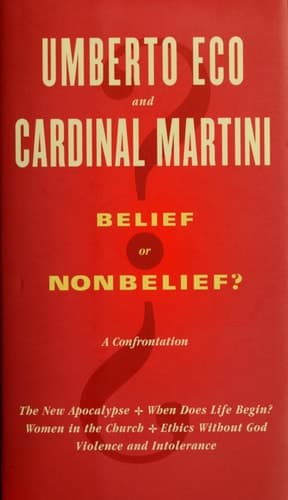
Belief Or Nonbelief? A Confrontation
Umberto EcoPublished2000
Pages102
Formathardcover
PublisherArcade Publishing
Synopsis
They stand on opposite ends of the spectrum: one is the world-famous author of The Name of the Rose and a self-declared secularist; the other is a senior member of the Catholic Church (often mentioned as a possible successor to the pope). In this amicable but adversarial exchange of letters and ideas, Eco and Martini debate abortion, women in the Catholic Church, ethics, and the apocalypse. They frame a debate that has begun to rage in this millennial year, aware of the gulf between belief and nonbelief that separates them. The result is illuminating. Where are the limits of belief? What can a nonbeliever believe? Some of America's most provocative writers and thinkers from across the spectrum of faiths and backgrounds offer their reaction to the subjects raised by Eco and Martini.
Recommendations
Generating recommendations…
Our AI is preparing recommendations for Belief Or Nonbelief? A Confrontation. This usually takes under a minute.
About Umberto Eco
U
Umberto Eco
1932–2016
Umberto Eco (5 January 1932 – 19 February 2016) was an Italian novelist, literary critic, philosopher, semiotician, and university professor. He is widely known for his 1980 novel Il nome della rosa (The Name of the Rose), a historical mystery combining semiotics in fiction with biblical analysis, medieval studies, and literary theory. He later wrote other novels, including Il pendolo di Foucault (Foucault's Pendulum) and L'isola del giorno prima (The Island of the Day Before). His novel Il cimitero di Praga (The Prague Cemetery), released in 2010, topped the bestseller charts in Italy. Eco also wrote academic texts, children's books, and essays, and edited and translated into Italian books from French, such as Raymond Queneau’s “Exercises in Style” (1983). He was the founder of the Department of Media Studies at the University of the Republic of San Marino,[3] president of the Graduate School for the Study of the Humanities at the University of Bologna, member of the Accademia dei Lincei, and an honorary fellow of Kellogg College, Oxford.
View author page