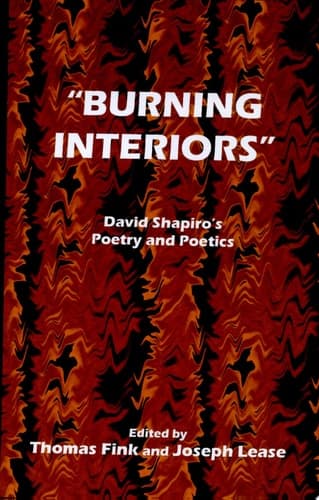
"Burning Interiors" David Shapiro's Poetry and Poetics
Thomas FinkPublished2007
Pages186
Formathardcover
PublisherFairleigh Dickinson Univ Press
Synopsis
"The material collected in "Burning Interiors" illuminates a useful range of Shapiro's major texts through diverse critical approaches and elucidates vital questions that Shapiro addresses about poetry's nature and cultural contexts in original, candid, philosophical, visionary, witty poems."--book jacket.
Recommendations
The Anxiety of Influence A Theory of Poetry
by Harold Bloom
Since you've just engaged with Fink's critical examination of Shapiro's poetics, Bloom's foundational work on how poets wrestle with their predecessors will deepen your understanding of poetry's philosophical underpinnings. Bloom writes with the same kind of visionary intensity that Fink attributes to Shapiro—he's not just analyzing poetry, he's making an argument about its essential nature and cultural weight.
View book
The Book of Disquiet
by Fernando Pessoa
Pessoa's fragmented, philosophical prose-poetry collection shares Shapiro's candid interrogation of consciousness and identity, but approaches it through a more lyrical, introspective lens. Where Fink describes Shapiro's work as addressing poetry's nature through original and witty means, Pessoa does something similar by questioning what it means to document an interior life across multiple selves—it's poetics enacted rather than theorized.
View book
The Style of Connectedness Gravity's Rainbow and Thomas Pynchon
by Thomas Moore
This might seem like a departure from literary criticism into maximalist fiction, but Pynchon's novel operates as a kind of anti-poetry that's obsessed with the same questions Shapiro asks: how do we represent meaning in a fragmented world? The novel's digressive, witty, visionary style mirrors the kind of intellectual playfulness Fink identifies in Shapiro's work, just channeled through narrative rather than verse.
View book
A Poet's Guide to Poetry
by Mary Kinzie
Kinzie's handbook approaches poetic craft with the same philosophical rigor and candor that characterizes Shapiro's own work as described by Fink. Rather than being a dry technical manual, it reads like a series of meditations on how form and meaning intertwine—perfect for someone who wants to understand not just what Shapiro's poetry does, but how to think about poetry's possibilities more broadly.
View book
The Prelude and Selected Poems, William Wordsworth Notes by Martin Gray
by Martin Gray
Published in 1850 (well before your source text), Wordsworth's autobiographical poem explores consciousness, memory, and the poet's relationship to culture in ways that clearly influenced modernist and contemporary poets like Shapiro. Reading this will show you the genealogy of the questions Shapiro is asking—how does the interior life become poetry, and what does that transformation reveal about human experience?
View bookAbout Thomas Fink
Biography coming soon.
View author page