Synopsis
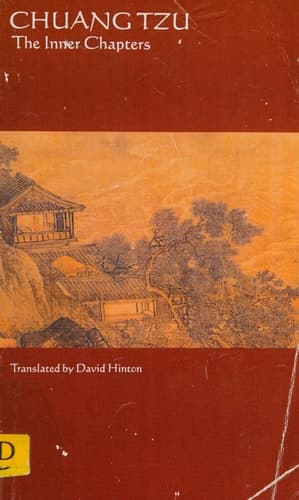
Revered for millennia in the Chinese spiritual tradition, Chuang Tze stands alongside the Tao Te Ching as a founding classic of Taoism. The Inner Chapters are the only sustained section of this text widely believed to be the work of Chuang Tzu himself, dating to the fourth century B.C.E. But this is an ancient text that yields a surprisingly modern effect. In bold and startling prose, David Hinton's translation captures the "zany texture and philosophical abandon" of the original. The Inner Chapters fantastical passages - in which even birds and trees teach us what they know - offer up a wild menagerie of characters, freewheeling play with language, and surreal humor. And interwoven with Chuang Tzu's sharp instruction on the Tao are short-short stories that are often rough and ribald, rich with satire and paradox. On their deepest level, the Inner Chapters are a meditation on the mysteries of knowledge itself.
Recommendations
Generating recommendations…
Our AI is preparing recommendations for Chuang Tzu The Inner Chapters. This usually takes under a minute.
About Zhuangzi
Zhuang Zhou, commonly known as Zhuangzi (Chinese: 莊子; literally "Master Zhuang"; also rendered as Chuang Tzu), was an influential Chinese philosopher who lived around the 4th century BC during the Warring States period, a period corresponding to the summit of Chinese philosophy, the Hundred Schools of Thought. He is credited with writing—in part or in whole—a work known by his name, the *Zhuangzi*, which is one of the foundational texts of Taoism. **Source**: [Zhuang Zhou](https://en.wikipedia.org/wiki/Zhuang_Zhou) on Wikipedia.
View author page