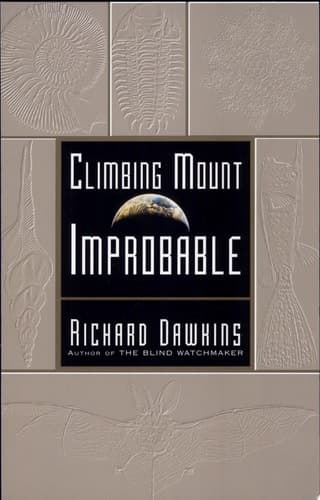
Climbing Mount Improbable
Richard DawkinsPublished1996
Pages340
Formatpaperback
PublisherW. W. Norton & Company
Synopsis
A brilliant book celebrating improbability as the engine that drives life, by the acclaimed author of The Selfish Gene and The Blind Watchmaker.
The human eye is so complex and works so precisely that surely, one might believe, its current shape and function must be the product of design. How could such an intricate object have come about by chance? Tackling this subject--in writing that the New York Times called "a masterpiece"--Richard Dawkins builds a carefully reasoned and lovingly illustrated argument for evolutionary adaptation as the mechanism for life on earth.
The metaphor of Mount Improbable represents the combination of perfection and improbability that is epitomized in the seemingly "designed" complexity of living things. Dawkins skillfully guides the reader on a breathtaking journey through the mountain's passes and up its many peaks to demonstrate that following the improbable path to perfection takes time. Evocative illustrations accompany Dawkins's eloquent descriptions of extraordinary adaptations such as the teeming populations of figs, the intricate silken world of spiders, and the evolution of wings on the bodies of flightless animals. And through it all runs the thread of DNA, the molecule of life, responsible for its own destiny on an unending pilgrimage through time.
Climbing Mount Improbable is a book of great impact and skill, written by the most prominent Darwinian of our age.
Recommendations
Generating recommendations…
Our AI is preparing recommendations for Climbing Mount Improbable. This usually takes under a minute.
About Richard Dawkins
R
Richard Dawkins
Born 1941
Clinton Richard Dawkins, FRS, FRSL is a British ethologist, evolutionary biologist and popular science author. He was formerly Professor for Public Understanding of Science at Oxford and was a fellow of New College, Oxford. Dawkins came to prominence with his 1976 book *The Selfish Gene*, which popularised the gene-centred view of evolution and introduced the term meme. In 1982, he made a widely cited contribution to evolutionary biology with the concept, presented in his book *The Extended Phenotype*, that the phenotypic effects of a gene are not necessarily limited to an organism's body, but can stretch far into the environment, including the bodies of other organisms. Dawkins is well known for his candid criticism of creationism and intelligent design. In his 1986 book *The Blind Watchmaker*, he argued against the watchmaker analogy, an argument for the existence of a supernatural creator based upon the complexity of living organisms. Instead, he described evolutionary processes as analogous to a blind watchmaker. He has since written several popular science books, and makes regular television and radio appearances, predominantly discussing these topics. ([Source][1]) [1]: http://en.wikipedia.org/wiki/Richard_Dawkins
View author page