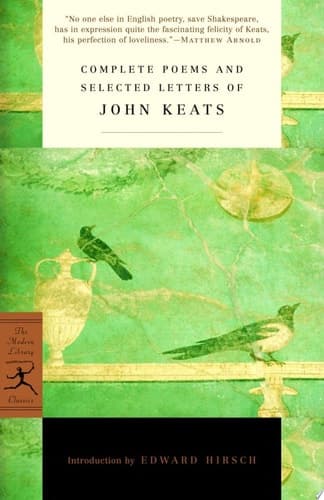
Complete Poems and Selected Letters of John Keats
John KeatsPublished2001
Pages640
Formatpaperback
PublisherRandom House Publishing Group
Synopsis
'I think I shall be among the English Poets after my death,' John Keats soberly prophesied in 1818 as he started writing the blankverse epic Hyperion. Today he endures as the archetypal Romantic genius who explored the limits of the imagination and celebrated the pleasures of the senses but suffered a tragic early death. Edmund Wilson counted him as 'one of the half dozen greatest English writers,' and T. S. Eliot has paid tribute to the Shakespearean quality of Keats's greatness. Indeed, his work has survived better than that of any of his contemporaries the devaluation of Romantic poetry that began early in this century. This Modern Library edition contains all of Keats's magnificent verse: 'Lamia,' 'Isabella,' and 'The Eve of St. Agnes'; his sonnets and odes; the allegorical romance Endymion; and the five-act poetic tragedy Otho the Great. Presented as well are the famous posthumous and fugitive poems, including the fragmentary 'The Eve of Saint Mark' and the great 'La Belle Dame sans Merci,' perhaps the most distinguished literary ballad in the language. 'No one else in English poetry, save Shakespeare, has in expression quite the fascinating felicity of Keats, his perception of loveliness,' said Matthew Arnold. 'In the faculty of naturalistic interpretation, in what we call natural magic, he ranks with Shakespeare.'
Recommendations
The Eve of Saint Hyacinth
by Unknown
Tennyson shares Keats's obsession with sensory richness and medieval atmospherics, but where Keats burns with intensity, Tennyson builds elaborate dreamscapes with almost jeweled precision. His narrative poems have that same intoxicating blend of romance and melancholy that makes Keats's 'Eve of St. Agnes' so haunting—you'll recognize the kinship immediately in how both poets use landscape and desire as intertwined forces.
View book
Wuthering Heights Emily Brontë
by Emily Bronte
This might seem like a departure from lyric poetry, but Brontë writes prose the way Keats writes verse—every sentence is weighted with emotional intensity, and she explores the same dangerous territory where beauty and destruction become indistinguishable. The raw passion and the way she renders landscape as a reflection of inner turmoil will feel familiar, even though you're reading a novel rather than poems.
View book
Samuel Taylor Coleridge, Selected Poems
by Samuel Taylor Coleridge
You've read Keats's letters—now read the poet who haunted Keats's imagination. Coleridge's fragmentary, visionary approach to poetry ('Christabel,' 'Kubla Khan') shows you the other side of Romantic genius: where Keats grounds beauty in the physical world, Coleridge dissolves it into dream and opium-haze. Together, they map the full territory of what Romantic poetry could do.
View book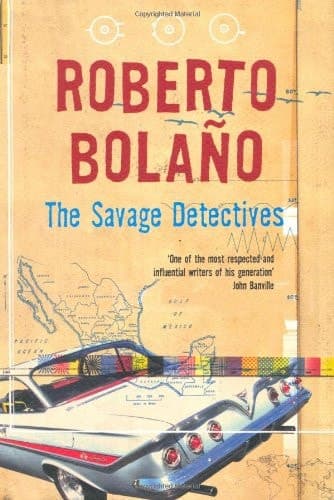
The Savage Detectives A Novel
by Roberto Bolaño
Here's your surprise: Bolaño's sprawling, obsessive novel about poets chasing a literary ghost has the same feverish intensity as Keats's letters—that sense of a mind burning through ideas and experiences at unsustainable speed. The book treats poetry and poets with the kind of reverence Keats himself demanded, and Bolaño's prose has an almost Romantic lushness beneath its fragmented structure. It's what happens when you give Keats's sensibility a 20th-century, Latin American reframing.
View bookAbout John Keats
J
John Keats
1795–1821
John Keats was the latest born of the great Romantic poets. Along with Byron and Shelley, he was one of the key figures in the second generation of the movement, despite publishing his work over only a four year period. During his short life, his work was not well received by critics, but his posthumous influence on poets such as Alfred Tennyson and Wilfred Owen was significant. The poetry of Keats was characterised by sensual imagery, most notably in the series of odes which remain among the most popular poems in English literature. The letters of Keats are among the most celebrated by any English poet. ([Source][1].) [1]:http://en.wikipedia.org/wiki/John_Keats
View author page