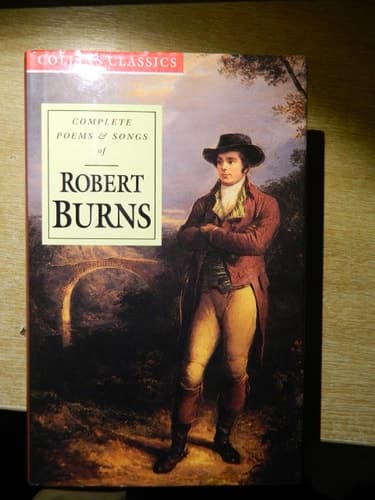
Complete Poems and Songs of Robert Burns
Robert BurnsPublished1995
Pages758
Formatpaperback
PublisherHarperCollins
Synopsis
Poems and Songs of Robert Burns, Complete and in chronological order: 1771 - 1796 includes a unique 1,980 word glossary so you can decipher the language of Robert Burns Burns' poetry falls into two main groups: English and Scottish. His English poems are, for the most part, inferior specimens of conventional eighteenth-century verse. But in Scottish poetry he achieved triumphs of a quite extraordinary kind. Since the time of the Reformation and the union of the crowns of England and Scotland, the Scots dialect had largely fallen into disuse as a medium for dignified writing.
Shortly before Burns' time, however, Allan Ramsay and Robert Fergusson had been the leading figures in a revival of the vernacular, and Burns received from them a national tradition which he succeeded in carrying to its highest pitch, becoming thereby, to an almost unique degree, the poet of his people. He first showed complete mastery of verse in the field of satire. In "The Twa Herds," "Holy Willie's Prayer," "Address to the Unco Guid," "The Holy Fair," and others, he manifested sympathy with the protest of the so-called "New Light" party, which had sprung up in opposition to the extreme Calvinism and intolerance of the dominant "Auld Lichts." The fact that Burns had personally suffered from the discipline of the Kirk probably added fire to his attacks, but the satires show more than personal animus. The force of the invective, the keenness of the wit, and the fervor of the imagination which they displayed, rendered them an important force in the theological liberation of Scotland.
Robert Burns (25 January 1759 - 21 July 1796) was a Scottish poet and lyricist. He is widely regarded as the national poet of Scotland and is celebrated worldwide. He is the best known of the poets who have written in the Scots language, although much of his writing is also in English and a light Scots dialect, accessible to an audience beyond Scotland. He also wrote in standard English, and in these his political or civil commentary is often at its bluntest.
Recommendations
Generating recommendations…
Our AI is preparing recommendations for Complete Poems and Songs of Robert Burns. This usually takes under a minute.
About Robert Burns
R
Robert Burns
1759–1796
Robert Burns (also known as Rabbie Burns, Scotland's favourite son, the Ploughman Poet, the Bard of Ayrshire and in Scotland as simply The Bard) was a Scottish poet and a lyricist. He is widely regarded as the national poet of Scotland, and is celebrated worldwide. He is the best known of the poets who have written in the Scots language, although much of his writing is also in English and a "light" Scots dialect, accessible to an audience beyond Scotland. He also wrote in standard English, and in these pieces, his political or civil commentary is often at its most blunt. He is regarded as a pioneer of the Romantic movement and after his death became a great source of inspiration to the founders of both liberalism and socialism. A cultural icon in Scotland and among the Scottish Diaspora around the world, celebration of his life and work became almost a national charismatic cult during the 19th and 20th centuries, and his influence has long been strong on Scottish literature. In 2009 he was voted by the Scottish public as being the Greatest Scot, through a vote run by Scottish television channel STV. ([Source][1]) [1]: http://en.wikipedia.org/wiki/Robert_Burns
View author page