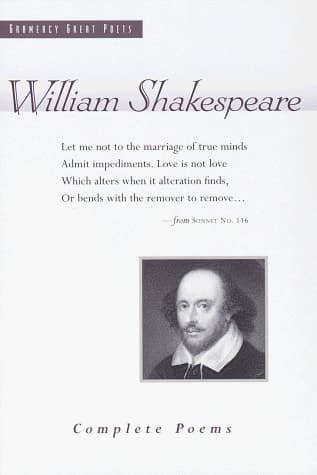
Synopsis
The great poets are now accessible in beautifully produced, in low-priced volumes. Each collection provides a wonderful overview of the poet's major works.
Recommendations
The Complete Works of Oscar Wilde: Poems and poems in prose
by Oscar Wilde
Wilde shares Shakespeare's gift for language that crackles with wit and double meanings, but his plays and essays are suffused with a Victorian sensibility that feels both familiar and refreshingly different. Where Shakespeare mines tragedy and comedy from human nature, Wilde weaponizes language itself—his characters don't just speak, they perform, and the effect is dazzling in a way that rewards rereading just like the sonnets do.
View book
Collected poems
by Emily Dickinson
If Shakespeare's sonnets feel like watching a master craftsman work in established forms, Dickinson is the poet who breaks the form entirely—her dashes and slant rhymes create this almost musical hesitation that forces you to slow down and sit with each word. She's working in a completely different century (1800s) and with a radically different aesthetic, but that compression of meaning into small spaces shares something profound with how Shakespeare packs entire philosophies into fourteen lines.
View book
The Apocalyptic Vision of Mikhail Bulgakov's the Master and Margarita (Studies in Slavic Language & Literature)
by Edward E. Ericson
This is the surprise pick: it's a novel, not poetry, but Bulgakov writes with such theatrical flair and linguistic playfulness that it reads like Shakespeare reimagined as a 20th-century Russian fever dream. The Devil arrives in Moscow, a poet's manuscript gets destroyed, and reality keeps slipping sideways—it has the same sense of human folly and cosmic irony that runs through *King Lear*, but filtered through Soviet absurdism and dark comedy.
View book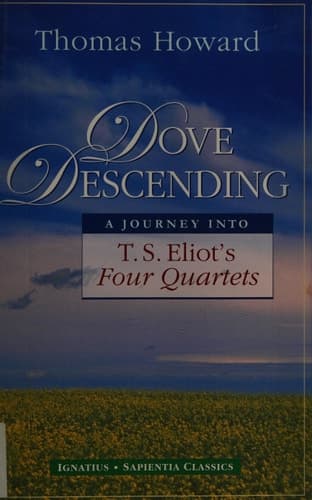
Dove Descending: A Journey into T.S. Eliot's Four Quartets (Sapientia Classics)
by Thomas Howard
Eliot's modernist masterpiece takes the meditative, philosophical impulse you find in Shakespeare's sonnets and stretches it across four long poems that feel like watching someone think in real time about time itself, memory, and meaning. The language is denser and more fragmented than Shakespeare, but there's that same sense of a brilliant mind working through fundamental human questions—just with 20th-century anxiety running underneath.
View book
The Odes of Pindar
by Pindar
Go backward instead of forward: Pindar was writing victory odes in ancient Greece centuries before Shakespeare, and his work shares that same combination of formal constraint and emotional intensity. His poems celebrate human achievement while simultaneously reminding us of mortality and fate—it's the same tonal balance Shakespeare achieves, and reading Pindar will actually deepen your appreciation for what Shakespeare inherited and transformed from the classical tradition.
View bookAbout William Shakespeare
W
William Shakespeare
1564–1616
William Shakespeare was an English poet and playwright, widely regarded as the greatest writer in the English language and the world's pre-eminent dramatist. He is often called England's national poet and the "Bard of Avon". His surviving works, including some collaborations, consist of 38 plays,[c] 154 sonnets, two long narrative poems, and several other poems. His plays have been translated into every major living language and are performed more often than those of any other playwright. He has invented over 1700 words some of which are common. ([Source][1].) [1]:https://en.wikipedia.org/wiki/William_Shakespeare Looking for the '[First Folio](https://openlibrary.org/works/OL362289W/Plays)'?
View author page