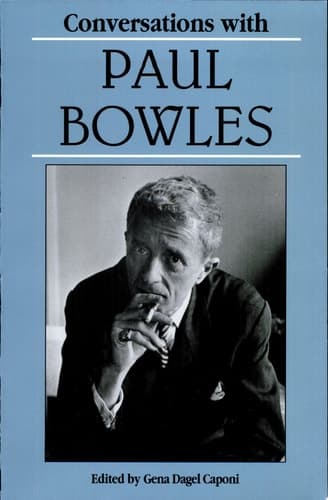
Conversations with Paul Bowles
Paul BowlesPublished1993
Pages254
Formatpaperback
PublisherUniv. Press of Mississippi
Synopsis
For the past forty years, Paul Bowles has answered questions about the autobiographical references in his novels (The Sheltering Sky, Let It Come Down, The Spider's House, and Up Above the World) and about his work as a composer in New York, all the time insisting, ""I don't want anyone to know about me.""In these more than twenty interviews dating from 1952 to the present, Bowles gives a variety of answers that reveal as much as they conceal. Too gracious to refuse interviews, he regards inquiries with the same clear-eyed detachment that marks his prose, wondering, ""Why is it that Americans expect an artist's work to be a reflection of his life? They never seem to want to believe that the two can be independent of each other and go their separate ways."" Despite his reticence, Bowles frankly discusses his ""unconscious"" writing practice, his views on the ""illiterate imagination,"" existentialism, his various experiments with altered states of consciousness, and nearly fifty years of expatriate life in Morocco.
Included are three interviews never before published, several interviews that originally appeared in now obscure journals, plus interviews by Jay Mclnerny for Vanity Fair, Jeffrey Bailey for The Paris Review, and Michael Rogers for Rolling Stone.
Recommendations
Generating recommendations…
Our AI is preparing recommendations for Conversations with Paul Bowles. This usually takes under a minute.
About Paul Bowles
P
Paul Bowles
1910–1999
Paul Frederic Bowles (December 30, 1910 – November 18, 1999) was an American expatriate composer, author, and translator. He became associated with Tangier, where he settled in 1947 and lived for 52 years to the end of his life. Following a cultured middle-class upbringing in New York City, during which he displayed a talent for music and writing, Bowles pursued his education at the University of Virginia before making several trips to Paris in the 1930s. He studied music with Aaron Copland, and in New York wrote music for theatrical productions, as well as other compositions. He achieved critical and popular success with his first novel The Sheltering Sky (1949), set in what was known as French North Africa, which he had visited in 1931. In 1947 Bowles settled in Tangier, at that time in the Tangier International Zone, and his wife Jane Bowles followed in 1948. Except for winters spent in Sri Lanka (then known as Ceylon) during the early 1950s, Tangier was Bowles' home for the remainder of his life. He came to symbolize American immigrants in the city. Paul Bowles died in 1999 at the age of 88. His ashes are buried near family graves in Lakemont Cemetery, in upstate New York.
View author page