
Crystals, Fabrics, and Fields Metaphors that Shape Embryos
Donna Jeanne HarawayPublished2004
Pages231
Formatpaperback
PublisherNorth Atlantic Books
Synopsis
Acclaimed theorist and social scientist Donna Jeanne Haraway uses the work of pioneering developmental biologists Ross G. Harrison, Joseph Needham, and Paul Weiss as a springboard for a discussion about a shift in developmental biology from a vitalism-mechanism framework to organicism. The book deftly interweaves Thomas Kuhn's concept of paradigm change into this wide-ranging analysis, emphasizing the role of model, analogy, and metaphor in the paradigm and arguing that any truly useful theoretical system in biology must have a central metaphor.
Recommendations

The Structure of Scientific Revolutions
by Thomas S. Kuhn
Since Haraway weaves Kuhn's paradigm theory throughout her analysis, reading the source material itself becomes essential—but here's the thing: Kuhn's prose is far more accessible than you'd expect for philosophy of science, and his historical examples (from astronomy to chemistry) will deepen your appreciation for how metaphors literally reshape what scientists can see. You'll recognize the framework Haraway was building on, and spot where she diverges into her own theoretical territory.
View book
The Selfish Gene
by Richard Dawkins
Dawkins does something Haraway critiques but also builds from: he takes a central metaphor—genes as selfish agents—and builds an entire theoretical system around it. Reading this will show you exactly the kind of metaphor-driven biology Haraway is examining, and you'll find yourself thinking critically about whether the metaphor limits or liberates our understanding of evolution. It's a productive disagreement waiting to happen in your head.
View book
Quilting and Braiding The Feminist Christologies of Sallie McFague and Elizabeth A. Johnson in Conversation
by Shannon Schrein
This is your surprise recommendation, but hear me out: Kimmerer, a botanist and member of the Citizen Potawatomi Nation, does something Haraway would recognize as crucial—she examines how different metaphorical frameworks (Western scientific versus Indigenous relational) shape what we can know about plants and ecosystems. Where Haraway traces metaphors in developmental biology, Kimmerer shows how choosing different foundational metaphors opens entirely different ways of being in relationship with nature.
View book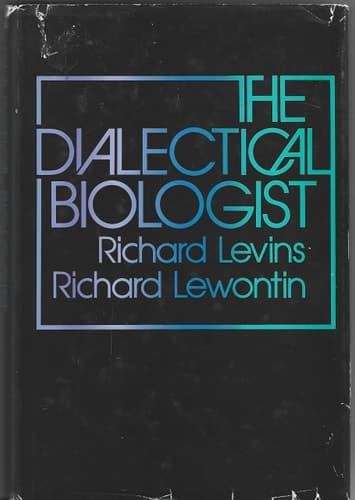
The dialectical biologist
by Richard Levins
Lewontin and Levins argue for dialectical materialism in biology—another alternative to the mechanism-vitalism binary Haraway discusses—and they're explicitly concerned with how our philosophical assumptions shape biological theory. They're denser than Haraway but operate in the same critical space, asking how ideology sneaks into science through our choice of models and metaphors. It's like watching two different theorists wrestle with the same fundamental problem.
View book
Simone de Beauvoir's the Second Sex
by George Myerson
Published in 1949, this takes us back several decades and into existential philosophy, but de Beauvoir does something Haraway clearly learned from: she traces how metaphors about women's bodies (as passive, receptive, natural) have been used to justify social and political structures. Reading this alongside Haraway shows you how the same critical attention to metaphor-as-power operates across biology, philosophy, and gender theory—it's the intellectual genealogy of Haraway's own project.
View bookAbout Donna Jeanne Haraway
Biography coming soon.
View author page