Synopsis
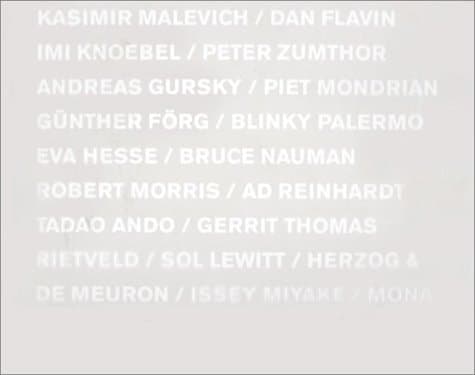
Rather than limit the minimal to being a type of visual art, the curators of "Minimalisms: A Sign of the Times" conceive of the minimal as a way of life, as a spirit that impregnates nearly the whole of modern culture and its surroundings. After an exhaustive overview of classic Minimalist works by Dan Flavin, Frank Stella, Agnes Martin, Carl Andre, and Elsworth Kelly, "Minimalisms" looks further, at artworks by Andreas Gursky, Candida Hoffer, Richard Serra, Jean-Marc Bustamante, and Gunther Forg, architecture by Peter Zumthor, Dominique Perrault, Claus En Kaan, and Rafael Moneo, furniture designs by Donald Judd and Shiro Kuramate, and fashion designs by Anni Albers, Donna Karan, and Issey Miyaki. Linking them all is a simplicity of form and ornament, a technical precision, and the essential and concrete nature of structure.
Essay by Anatxu Zabalbeascoa & Javier Rodriguez Marcos. Artists include: Anni Albers, Josef Albers, Helmut Federle, Dan Flavin, Andreas Gursky, Mona Hatoum, Eva Hesse, Candida Hofer, Tom Johnson, Donald Judd, Sol Lewitt, Kasimir Malevich, Mark Rothko, Richard Serra, and Frank Stella. Designers include: Donna Karan, Jean Nouvel. Architects include: Mies van der Rohe, Rafael Moneo and Peter Zumthor.
9.5 x 11 in.
100 color, 50 duotone illustrations
English/Spanish
Recommendations
Cultural Complexity in Organizations Inherent Contrasts and Contradictions
by Sonja Sackmann
You've just explored how minimalism functions as a philosophy across disciplines—Venturi does the inverse, arguing for richness and ambiguity in architectural thinking. Where Rodriguez Marcos celebrates essential form, Venturi provocatively asks what we lose when we strip away contradiction and complexity, making this a fascinating philosophical counterpoint that deepens your understanding of the minimalist impulse by questioning it.
View book
The Poetics of Space
by Gaston Bachelard
This 1958 meditation on how we inhabit spaces shares minimalism's reverence for essential form, but Bachelard approaches it through phenomenology and memory rather than visual aesthetics. He finds profundity in simple architectural elements—a corner, a threshold, a wall—the way your book finds it in Judd's spare sculptures, but his lens is intimate and psychological rather than curatorial.
View book
The Savage Detectives A Novel
by Roberto Bolaño
Here's the surprise: Bolaño's sprawling, digressive novel operates by a kind of literary minimalism—stripping away conventional narrative structure to expose only what's essential about obsession, art-making, and the hunt for meaning. Like the architects in your book who use constraint as liberation, Bolaño uses fragmentation and absence to create something paradoxically richer than conventional storytelling would allow.
View book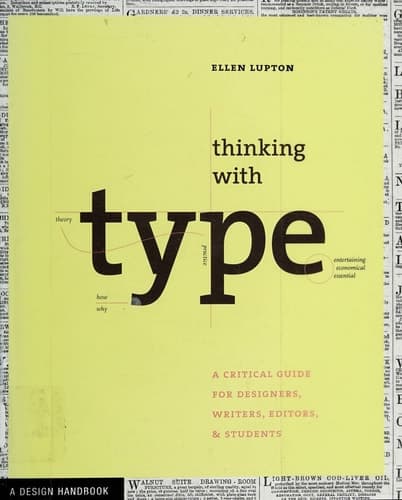
Thinking with Type: A Primer for Deisgners A Critical Guide for Designers, Writers, Editors, & Students
by Ellen Lupton
Lupton applies the same curatorial intelligence you've just encountered to typography and graphic design—showing how letterforms embody minimalist principles of clarity, precision, and structural honesty. She writes with the same eye for how form communicates across media, whether it's a Helvetica typeface or a Donald Judd installation, making this a natural extension into how minimalism shapes the language we read.
View book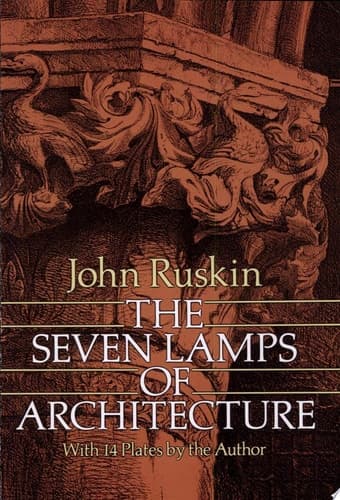
The Seven Lamps of Architecture
by John Ruskin
Published in 1849, Ruskin's passionate manifesto about architectural virtue predates modernism entirely, yet his insistence on honesty of materials and rejection of ornamental excess anticipates minimalist thinking by over a century. Reading this alongside your contemporary minimalism book reveals how the impulse toward essential form isn't new—it's a recurring ethical conviction about what buildings and objects owe us.
View bookAbout Javier Rodriguez Marcos
Biography coming soon.
View author page