Synopsis
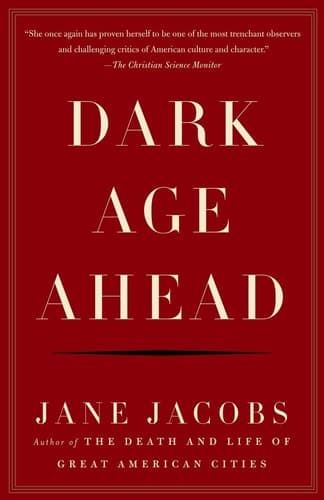
In this indispensable book, urban visionary Jane Jacobs argues that as agrarianism gives way to a technology-based future, we’re at risk of cultural collapse. Jacobs—renowned author of The Death and Life of Great American Cities and The Economy of Cities—pinpoints five pillars of our culture that are in serious decay: community and family; higher education; the effective practice of science; taxation, and government; and the self-regulation of the learned professions. The corrosion of these pillars, Jacobs argues, is linked to societal ills such as environmental crisis, racism, and the growing gulf between rich and poor.
But this is a hopeful book as well as a warning. Drawing on a vast frame of reference—from fifteenth-century Chinese shipbuilding to Ireland’s cultural rebirth—Jacobs suggests how the cycles of decay can be arrested and our way of life renewed. Invigorating and accessible, Dark Age Ahead is not only the crowning achievement of Jane Jacobs’ career, but one of the most important works of our time.
Recommendations
Generating recommendations…
Our AI is preparing recommendations for Dark Age Ahead. This usually takes under a minute.
About Jane Jacobs
J
Jane Jacobs
1916–2006
Jane Jacobs (born Jane Butzner; May 4, 1916 – April 25, 2006) was a Canadian and American journalist, author, and activist best known for her influence on urban studies. Her influential book *The Death and Life of Great American Cities* (1961) argued that urban renewal did not respect the needs of most city-dwellers. The book also introduced sociology concepts such as "eyes on the street" and "social capital". Jacobs was well known for organizing grassroots efforts to protect existing neighborhoods from "slum clearance" – and particularly for her opposition to Robert Moses in his plans to overhaul her neighborhood, Greenwich Village. She was instrumental in the eventual cancellation of the Lower Manhattan Expressway, which would have passed directly through SoHo and Little Italy, and was arrested in 1968 for inciting a crowd at a public hearing on the project. After moving to Toronto in 1968, she joined the opposition to the Spadina Expressway and the associated network of expressways in Toronto planned and under construction. As a mother and a female writer who criticized experts in the male-dominated field of urban planning, Jacobs endured scorn from established figures, who called her a "housewife" and a "crazy dame." She did not have a college degree, or any formal training in urban planning, and was criticized for being unscholarly and imprecise. She was also accused of inattention to racial inequality, and her concept of "unslumming" has been compared with gentrification. <u>Source</u>: Jane Jacobs. (2016, May 4). In *Wikipedia, The Free Encyclopedia*. Retrieved 10:55, May 4, 2016, from `https://en.wikipedia.org/w/index.php?title=Jane_Jacobs&oldid=718578863`
View author page