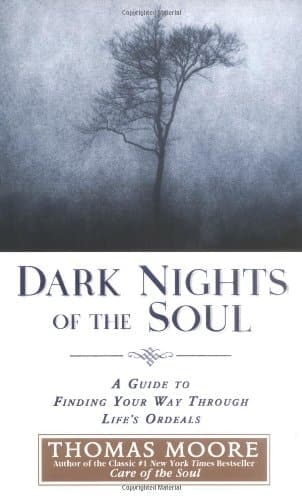
Dark Nights of the Soul A Guide to Finding Your Way Through Life's Ordeals
Thomas MoorePublished2004
Pages329
Formathardcover
PublisherGotham Books
Synopsis
“Every human life is made up of the light and the dark, the happy and the sad, the vital and the deadening. How you think about this rhythm of moods makes all the difference.”
From the #1 New York Timesbestselling author of Care of the Soulcomes the long-anticipated sequel, an uplifting and groundbreaking approach to life’s darkest hours
Every human journey is filled with emotional tunnels: the loss of a loved one or end of a relationship, aging and illness, career disappointments or just an ongoing sense of dissatisfaction with life. Society tends to view these “dark nights” in clinical terms as obstacles to be overcome as quickly as possible. But Thomas Moore’s extensive career as a psychologist and theologian has taught him that honoring these periods of fragility as periods of incubation and opportunities to delve the soul’s deepest needs can provide healing and a new understanding of life’s meaning. Dark Nights of the Soulpresents these metaphoric dark nights not as the enemy, but as times of transition, occasions to restore yourself, and transforming rites of passage. Moore shows specific ways to engage life more deeply through particular challenges and shares a powerful new outlook on such topics as:
- The healing power of melancholy
- The sexual dark night and the mysteries of matrimony
- Finding solace during illness and in aging
- Anxiety, anger, and temporary Insanities
- Linking creativity, spirituality, and emotional struggles
- Finding meaning and beauty in the darkness
With the soothing, accessible tone and practical philosophy that have made Moore an internationally beloved author, Dark Nights of the Soulwill help you tend to the deepest needs of the heart and spirit in a modern world full of life’s challenges, and is sure to be a comforting companion during your most difficult times.
Recommendations

The Year of Magical Thinking A Play by Joan Didion Based on Her Memoir
by Joan Didion
Where Moore offers philosophical frameworks for understanding grief, Didion does something rawer—she documents the actual texture of loss through precise, unflinching observation. Both writers refuse to rush you through darkness, but Didion's memoir approach gives you the granular, moment-to-moment experience of a dark night that Moore's more archetypal approach contextualizes. It's like reading the lived experience that Moore's theology was built to honor.
View book
The Book of Awakening Having the Life You Want by Being Present to the Life You Have
by Mark Nepo
Nepo shares Moore's conviction that difficulty contains wisdom, but he approaches it through daily meditations rather than thematic essays. If you found Moore's accessible spirituality comforting, Nepo's practice-oriented companion will feel like a natural next step—something you can return to repeatedly rather than read straight through. Both authors write for people who want meaning without dogma.
View book
The Savage Detectives A Novel
by Roberto Bolaño
This might seem like a left turn, but stay with me: Bolaño's novel is fundamentally about how people construct meaning through connection and obsession, even (especially) when life is fragmentary and disappointing. Where Moore gives you a map for the dark night, Bolaño gives you the lived experience of characters stumbling through their own—messier, funnier, more disorienting than Moore's framework, but operating from the same belief that the struggle itself matters. It's Moore's philosophy as lived fiction.
View book
Traveling Mercies Some Thoughts on Faith
by Anne Lamott
Lamott writes memoir essays about faith, doubt, and recovery with the same generous, non-judgmental tone Moore uses, but she's grittier about addiction, failure, and the messy human reality underneath spiritual insight. Where Moore is the theologian-psychologist, Lamott is the friend who's been through it and lived to tell funny, heartbreaking stories. Both believe grace arrives through acceptance rather than resistance.
View book
The Poetics of Space
by Gaston Bachelard
Published in 1958, this philosophical meditation on how physical spaces shape our inner lives offers something different from Moore's temporal approach to darkness—Bachelard shows how our relationship to home, shelter, and intimate spaces reveals and heals the soul. It's denser and more theoretical than Moore, but if you're ready to deepen your thinking about how the material world participates in spiritual transformation, Bachelard's poetic philosophy will expand what you mean by 'soul work.'
View bookAbout Thomas Moore
T
Thomas Moore
Born 1946
Roméo Antonius Dallaire OC CMM GOQ MSC CD is a Canadian humanitarian, author, retired senator and Canadian Forces lieutenant-general. Dallaire served as force commander of UNAMIR, the ill-fated United Nations peacekeeping force for Rwanda between 1993 and 1994, and attempted to stop the genocide that was being waged by Hutu extremists against the Tutsi people and Hutu moderates. *-- Wikipedia* *Photo Attribution:* Michelle Campbell, CEO, St Joseph's Health Care Foundation, London Ontario, CC BY-SA 4.0 <https://creativecommons.org/licenses/by-sa/4.0>, via Wikimedia Commons
View author page