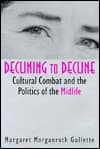
Declining to Decline: Cultural Combat and the Politics of the Midlife (Age Studies)
Margaret Morganroth GullettePublished1997
Pages276
Formathardcover
PublisherUniv of Virginia Pr
Synopsis
In Declining to Decline, Margaret Morganroth Gullette argues that in America aging is a culturally constructed disease with an adolescent exposure and a midlife onset.Targeting men as well as women, our culture pressures us to shed youthful attributes and optimism about the future. This, she says, constitutes the"midlife crisis" of our time- not a private psychological condition but a collective problem. Even our reactions have been channeled: buying remedies, telling stories of self-hating nostalgia, feeling envy of youth, alienation from the elderly, and fear of fifty.
Gullette asks us to open our eyes to this manipulation and to resist it. This controversial call to arms is part autobiography, part cultural commentary, part theory, and part passion. In moving, skeptical, funny stories Gullette reflects on her childhood revenge fantasies, her political anguish, the early diagnosis of her arthritis, the rifts between midlife mothers and adult children, and her 25th college reunion. Analyzing cartoons, fiction, films, and news, Declining to Decline addresses the full spectrum of midlife phenomena, from the sexual politics of midlife male bodies, to the contradictions of menopausal discourse, to how middle-ageism comes into play in a downsizing economy.
Gullette reasons that forming a new anti-"middleage"-ist community depends on understanding how thoroughly and subtly culture now constructs midlife selfhood and expects our subservience. Evolving out of this subservience, the author proposes the concept of "age identity", a complex and satisfying way of telling our narratives of being and becoming over the entire life course.
Declining to Decline.Cultural Combat and the Politics of the Midlife was chosen as thebest feminist book on American popular culture by the American Culture/PopularCulture Associations. The winner of the 1998 Emily Toth Award virtuallyestablishes a new interdisciplinary domain: the social construction of themiddle years.
Recommendations
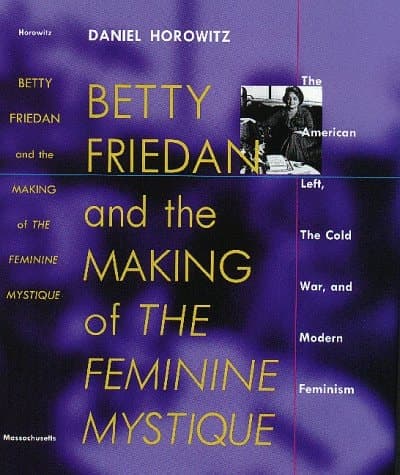
Betty Friedan: And the Making of the Feminine Mystique :The American Left, the Cold War, and Modern Feminism (Culture, Politics, and the Cold War)
by Daniel Horowitz
Friedan's 1963 classic dissects how culture manufactures discontent in women's lives—the same analytical muscle Gullette flexes, but focused on an earlier generation's crisis point. Where Gullette examines how midlife becomes a constructed disease, Friedan exposes how domesticity itself was sold as fulfillment while systematically erasing women's ambitions. Reading them together shows how these cultural narratives evolve and persist across decades.
View book
Hunger A Modern History
by James Vernon
Brownstein's memoir does something Gullette does brilliantly—it refuses the expected narrative arc. Rather than a tidy coming-of-age story, she examines how identity gets constructed and reconstructed through culture, music, and community, with the same skeptical eye toward received wisdom about who we're supposed to become. It's part autobiography, part cultural commentary, and deeply funny about the stories we tell ourselves.
View book
Simone de Beauvoir's the Second Sex
by George Myerson
Here's where Gullette's intellectual genealogy leads—de Beauvoir's foundational argument that 'one is not born, but rather becomes, a woman' is the philosophical bedrock under Gullette's concept of 'age identity.' De Beauvoir examines how culture scripts our bodies and futures across the lifespan, making her analysis of aging and women's midlife particularly resonant with Gullette's intervention.
View book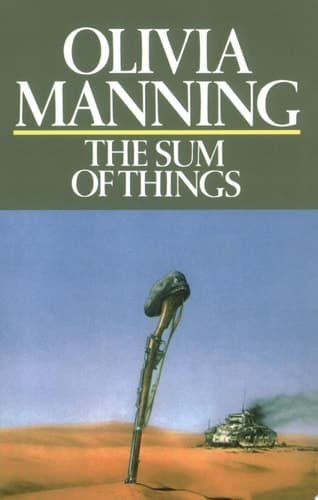
The Sum of Things
by Olivia Manning
Currid-Halkett updates Veblen's analysis of conspicuous consumption for the contemporary moment, examining how status anxiety drives our choices—including the anti-aging industry Gullette critiques. She traces how cultural messaging about what we should buy, become, and display creates a system of control that's remarkably similar to the 'middleage-ism' Gullette identifies, but she focuses on consumption patterns as the mechanism of that control.
View book
The Argonauts
by Aleister Crowley
This is your surprise recommendation—it's a genre-bending meditation on identity, bodies, and time that approaches these questions through queer theory and personal narrative rather than straightforward cultural criticism. Nelson's willingness to hold contradictions, her refusal of neat conclusions, and her insistence that how we live our identities matters as much as what we think about them will feel like a natural extension of Gullette's work, just applied to different (and deliberately unsettled) categories of selfhood.
View bookAbout Margaret Morganroth Gullette
Biography coming soon.
View author page