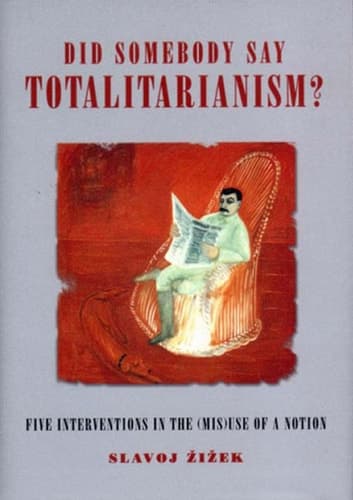
Did Somebody Say Totalitarianism?: Five Interventions in the (Mis)use of a Notion
Slavoj ŽižekPublished2001
Pages160
Formathardcover
PublisherVerso
Synopsis
In some circles, a nod towards totalitarianism is enough to dismiss any critique of the status quo. Such is the insidiousness of the neo-liberal ideology, argues Slavoj iek. Did Somebody Say Totalitarianism? turns a specious rhetorical strategy on its head to identify a network of family resemblances between totalitarianism and modern liberal democracy. iek argues that totalitarianism is invariably defined in terms of four things: the Holocaust as the ultimate, diabolical evil; the Stalinist gulag as the alleged truth of the socialist revolutionary project; ethnic and religious fundamentalisms, which are to be fought through multiculturalist tolerance; and the deconstructionist idea that the ultimate root of totalitarianism is the ontological closure of thought. iek concludes that the devil lies not so much in the detail but in what enables the very designation totalitarian: the liberal-democratic consensus itself.
Recommendations
Generating recommendations…
Our AI is preparing recommendations for Did Somebody Say Totalitarianism?: Five Interventions in the (Mis)use of a Notion. This usually takes under a minute.
About Slavoj Žižek
S
Slavoj Žižek
Born 1949
Slavoj Žižek is Senior Researcher at the Institute for Social Sciences at the University of Ljubljana, Slovenia. He is a coeditor of Gaze and Voice as Love Objects and author of Tarrying with the Negative, both published by Duke University Press.
View author page