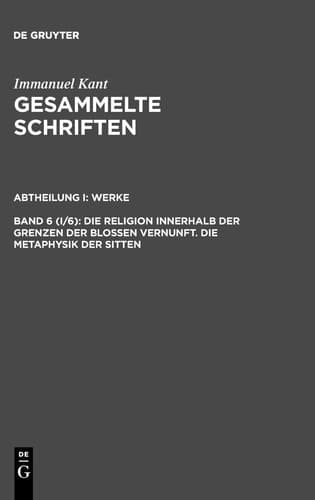
Die Religion Innerhalb der Grenzen der Blossen Vernunft. Die Metaphysik der Sitten
Immanuel KantPublished1969
Pages559
Formathardcover
PublisherDe Gruyter, Incorporated
Synopsis
Die im Jahr 1902 von der Königlich Preußischen Akademie der Wissenschaften begonnene Ausgabe von Kants gesammelten Schriften ist bis heute die maßgebliche Kant-Edition. Die kritische Ausgabe gliedert sich in 4 Abteilungen:
In Abt. I werden in 9 Bänden die Werke, in Abt. II (Bd 10-13, Nachtrag Bd 23) der Briefwechsel Kants ediert. Abt. III (Bd 14-23) enthält den Handschriftlichen Nachlass Kants. Die Edition der Vorlesungen in Abt. IV ist noch nicht abgeschlossen, bislang liegen die Bde 24-25 und 27-29 vor.
Jeder Band enthält sachliche Erläuterungen sowie einen Apparat zu den Lesarten. Ein Wortindex (Bd 16) sowie ein Personenindex (Bd 20) helfen, das Werk zu erschließen.
Recommendations
Generating recommendations…
Our AI is preparing recommendations for Die Religion Innerhalb der Grenzen der Blossen Vernunft. Die Metaphysik der Sitten. This usually takes under a minute.
About Immanuel Kant
I
Immanuel Kant
1724–1804
Immanuel Kant was an 18th-century German philosopher from the Prussian city of Königsberg. Kant was the last influential philosopher of modern Europe in the classic sequence of the theory of knowledge during the Enlightenment beginning with thinkers John Locke, George Berkeley, and David Hume. Kant created a new perspective in philosophy which had widespread influences on philosophy continuing through to the 21st century. He published important works on epistemology, as well as works relevant to religion, law, and history. One of his most prominent works is the *Critique of Pure Reason*, an investigation into the limitations and structure of reason itself. It encompasses an attack on traditional metaphysics and epistemology, and highlights Kant's own contribution to these areas. The other main works of his maturity are the *Critique of Practical Reason*, which concentrates on ethics, and the *Critique of Judgment*, which investigates aesthetics and teleology. <sup>[1][1]</sup> [1]: https://en.wikipedia.org/wiki/Immanuel_Kant
View author page