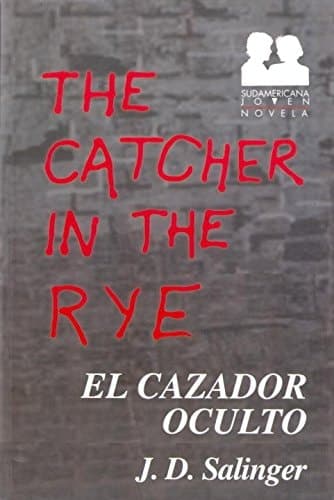
El Cazador Oculto
Jerome David SalingerPublished2001
Pages256
Formatpaperback
PublisherEditorial Sudamericana S.A.
Synopsis
Since its first publication in 1951, the critically acclaimed story of The Catcher in the Rye has stood as one of the definitive emblems of disillusioned adolescence. Through the words of Holden Cawfield, The Catcher in the Rye shows the anguish of a generation, one that receives its sentimental education in the postwar era and has to confront the absurdities of a conformist and rigidly conventional society. Holden is one of the most memorable and universally recognized characters of twentieth century literature.
Recommendations
Generating recommendations…
Our AI is preparing recommendations for El Cazador Oculto. This usually takes under a minute.
About Jerome David Salinger
J
Jerome David Salinger
1919–2010
Jerome David Salinger (January 1, 1919 – January 27, 2010) was an American author best known for his 1951 novel *The Catcher in the Rye.* Salinger published several short stories in *Story* magazine in 1940, before serving in World War II. In 1948, his critically acclaimed story *A Perfect Day for Bananafish* appeared in *The New Yorker,* which published much of his later work. *The Catcher in the Rye* was an immediate popular success; Salinger's depiction of adolescent alienation and loss of innocence was influential, especially among adolescent readers. The novel was widely read and controversial, and its success led to public attention and scrutiny. Salinger became reclusive, publishing less frequently. He followed *Catcher* with a short story collection, *Nine Stories* (1953); *Franny and Zooey* (1961), a volume containing a novella and a short story; and a volume containing two novellas, *Raise High the Roof Beam, Carpenters* and *Seymour: An Introduction* (1963). Salinger's last published work, the novella *Hapworth 16, 1924,* appeared in *The New Yorker* on June 19, 1965. Source: [Wikipedia](https://en.wikipedia.org/wiki/J._D._Salinger)
View author page