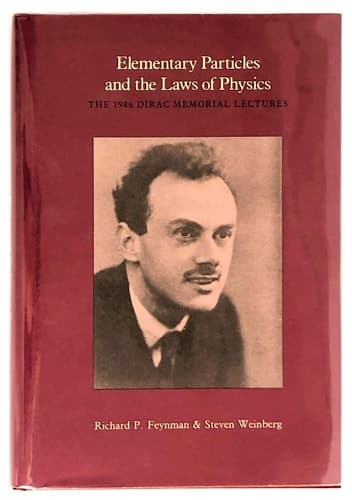
Elementary Particles and the Laws of Physics: The 1986 Dirac Memorial Lectures
Richard P. FeynmanPublished1987
Pages124
Formathardcover
PublisherCambridge University Press
Synopsis
Developing a theory that seamlessly combines relativity and quantum mechanics, the most important conceptual breakthroughs in twentieth century physics, has proved to be a difficult and ongoing challenge. This book details how two distinguished physicists and Nobel laureates have explored this theme in two lectures given in Cambridge, England, in 1986 to commemorate the famous British physicist Paul Dirac. Given for nonspecialists and undergraduates, the talks transcribed in Elementary Particles and the Laws of Physics focus on the fundamental problems of physics and the present state of our knowledge. Professor Feynman examines the nature of antiparticles, and in particular the relationship between quantum spin and statistics. Professor Weinberg speculates on how Einstein's theory of gravitation might be reconciled with quantum theory in the final law of physics. Highly accessible, deeply thought provoking, this book will appeal to all those interested in the development of modern physics.
Recommendations
Generating recommendations…
Our AI is preparing recommendations for Elementary Particles and the Laws of Physics: The 1986 Dirac Memorial Lectures. This usually takes under a minute.
About Richard P. Feynman
R
Richard P. Feynman
1918–1988
Richard Phillips Feynman was an American theoretical physicist known for his work in the path integral formulation of quantum mechanics, the theory of quantum electrodynamics, and the physics of the superfluidity of supercooled liquid helium, as well as in particle physics for which he proposed the parton model. For his contributions to the development of quantum electrodynamics, Feynman, jointly with Julian Schwinger and Sin-Itiro Tomonaga, received the Nobel Prize in Physics in 1965. - Wikipedia
View author page