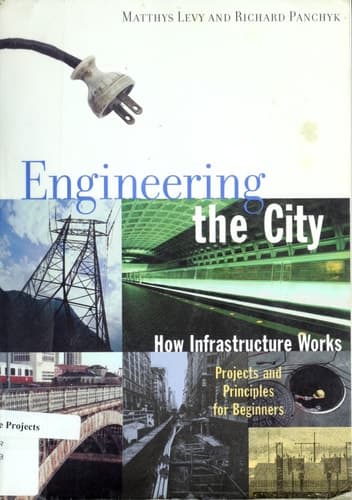
Engineering the City How Infrastructure Works : Projects and Principles for Beginners
Matthys LevyPublished2000
Pages129
Formatpaperback
PublisherChicago Review Press
Synopsis
How does a city obtain water, gas, and electricity? Where do these services come from? How are they transported? The answer is infrastructure, or the inner, and sometimes invisible, workings of the city. Roads, railroads, bridges, telephone wires, and power lines are visible elements of the infrastructure; sewers, plumbing pipes, wires, tunnels, cables, and sometimes rails are usually buried underground or hidden behind walls. Engineering the City tells the fascinating story of infrastructure as it developed through history along with the growth of cities. Experiments, games, and construction diagrams show how these structures are built, how they work, and how they affect the environment of the city and the land outside it.
Recommendations
Generating recommendations…
Our AI is preparing recommendations for Engineering the City How Infrastructure Works : Projects and Principles for Beginners. This usually takes under a minute.
About Matthys Levy
M
Matthys Levy
Born 1929
Mattys Levy, an architectural engineer for 38 years, has won numerous awards, including the AIA Institute Honor Award. Levy and his *Why Buildings Fall Down* co-author Mario Salvadori are principals of Weidlinger Associates, Consulting Engineers, one of America's leading structural engineering firms.—*Why Buildings Fall Down* jacket
View author page