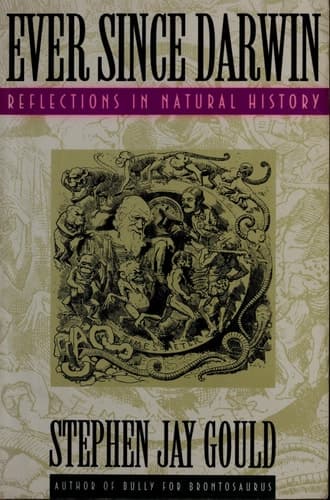
Ever Since Darwin: Reflections in Natural History
Stephen Jay GouldPublished1992
Pages285
Formatpaperback
PublisherW. W. Norton & Company
Synopsis
More than any other modern scientists, Stephen Jay Gould has opened up to millions the wonders of evolutionary biology. His genius as an essayist lies in his unmatched ability to use his knowledge of the world, including popular culture, to illuminate the realm of science.
Ever Since Darwin, Stephen Jay Gould's first book, has sold more than a quarter of a million copies. Like all succeeding collections by this unique writer, it brings the art of the scientific essay to unparalleled heights.
Recommendations
The Selfish Gene
by Richard Dawkins
Dawkins shares Gould's gift for making evolutionary concepts viscerally clear, but he approaches the subject from a radically different angle—viewing evolution through the lens of genes rather than organisms. Where Gould delights in historical contingency and the messiness of nature, Dawkins builds elegant, almost mathematical arguments that feel like watching someone solve a puzzle in real time. You'll find yourself arguing with both authors simultaneously, which is exactly the point.
View book
Quilting and Braiding The Feminist Christologies of Sallie McFague and Elizabeth A. Johnson in Conversation
by Shannon Schrein
Kimmerer writes with the same lyrical precision Gould brought to paleontology, but she's weaving together botany, indigenous philosophy, and personal memoir into something that feels less like a science book and more like a conversation with someone who sees the world with uncommon clarity. If you appreciated how Gould could make you care deeply about snails and trilobites, Kimmerer will do the same for moss and mycorrhizal networks—but she'll also challenge you to think about your relationship with the natural world.
View book
The Demon-haunted World Science as a Candle in the Dark
by Carl Sagan
This is Gould's intellectual cousin—a scientist using essays and cultural references to defend scientific thinking itself. Sagan has that same ability to move from ancient history to contemporary politics to astronomy in a single paragraph, and he shares Gould's conviction that science isn't dry or reductive but rather the most honest way we have of understanding reality. Where Gould focuses on what evolution reveals, Sagan focuses on why we need science at all.
View book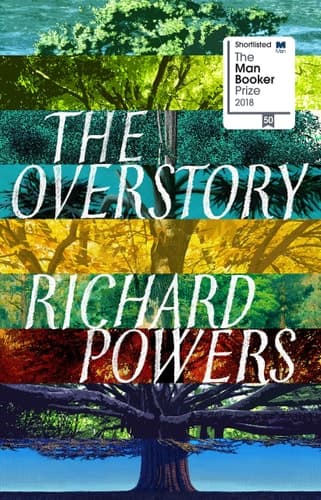
The Overstory A Novel
by Richard Powers
Here's the surprise: Powers is a novelist, not a scientist, but he's written a book that reads like an extended meditation on ecology, interconnectedness, and deep time—themes that run beneath Gould's work. The prose is dense and sometimes challenging, but Powers has that same ability to make you see the world differently, to notice patterns you'd missed. It's what happens when someone with a scientific imagination writes fiction instead of essays.
View bookAbout Stephen Jay Gould
Biography coming soon.
View author page