Synopsis
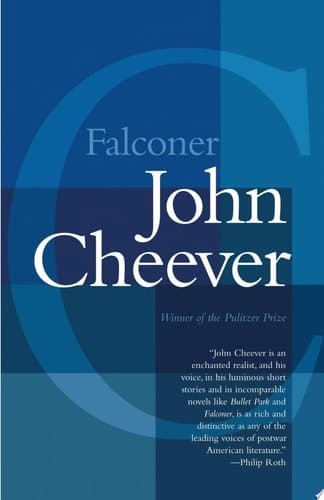
#1 NEW YORK TIMES BESTSELLER • Stunning and brutally powerful, "one of the most important novels of our time" (The New York Times) tells the story of a man named Farragut, his crime and punishment, and his struggle to remain a man in a universe bent on beating him back into childhood.
In a nightmarish prison, out of Farragut's suffering and astonishing salvation, Pulitzer Prize-winning author John Cheever crafted his most powerful work of fiction. Only Cheever could deliver these grand themes with the irony, unforced eloquence, and exhilarating humor that make Falconer such a triumphant work of the moral imagination.
Recommendations
Generating recommendations…
Our AI is preparing recommendations for Falconer. This usually takes under a minute.
About John Cheever
J
John Cheever
1912–1982
**John William Cheever** (May 27, 1912 – June 18, 1982) was an American short story writer and novelist. He is sometimes called "the Chekhov of the suburbs". His fiction is mostly set on the Upper East Side of Manhattan; the Westchester suburbs; old New England villages based on various South Shore towns around Quincy, Massachusetts, where he was born; and Italy, especially Rome. His short stories included *The Enormous Radio, Goodbye, My Brother, The Five-Forty-Eight, The Country Husband,* and *The Swimmer,* and he also wrote five novels: *The Wapshot Chronicle* (National Book Award, 1958), *The Wapshot Scandal* (William Dean Howells Medal, 1965), *Bullet Park* (1969), *Falconer* (1977) and a novella, *Oh What a Paradise It Seems* (1982). A compilation of his short stories, *The Stories of John Cheever,* won the 1979 Pulitzer Prize for Fiction and a National Book Critics Circle Award, and its first paperback edition won a 1981 National Book Award. On April 27, 1982, six weeks before his death, Cheever was awarded the National Medal for Literature by the American Academy of Arts and Letters. His work has been included in the Library of America.
View author page