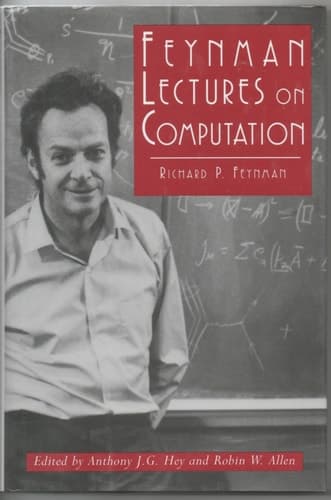
Feynman Lectures on Computation
Richard P. FeynmanPublished1996
Pages303
Formathardcover
PublisherAddison-Wesley
Synopsis
From 1983 to 1986, the legendary physicist and teacher Richard Feynman gave a course at Caltech called Potentialities and Limitations of Computing Machines.”Although the lectures are over ten years old, most of the material is timeless and presents a Feynmanesque” overview of many standard and some not-so-standard topics in computer science. These include computability, Turing machines (or as Feynman said, Mr. Turing's machines”), information theory, Shannon's Theorem, reversible computation, the thermodynamics of computation, the quantum limits to computation, and the physics of VLSI devices. Taken together, these lectures represent a unique exploration of the fundamental limitations of digital computers.Feynman's philosophy of learning and discovery comes through strongly in these lectures. He constantly points out the benefits of playing around with concepts and working out solutions to problems on your own-before looking at the back of the book for the answers. As Feynman says in the lectures: If you keep proving stuff that others have done, getting confidence, increasing complexities of your solutions-for the fun of it-then one day you'll turn around and discovers that nobody actually did that one! And that's the way to become a computer scientist.”
Recommendations
Generating recommendations…
Our AI is preparing recommendations for Feynman Lectures on Computation. This usually takes under a minute.
About Richard P. Feynman
R
Richard P. Feynman
1918–1988
Richard Phillips Feynman was an American theoretical physicist known for his work in the path integral formulation of quantum mechanics, the theory of quantum electrodynamics, and the physics of the superfluidity of supercooled liquid helium, as well as in particle physics for which he proposed the parton model. For his contributions to the development of quantum electrodynamics, Feynman, jointly with Julian Schwinger and Sin-Itiro Tomonaga, received the Nobel Prize in Physics in 1965. - Wikipedia
View author page