Synopsis
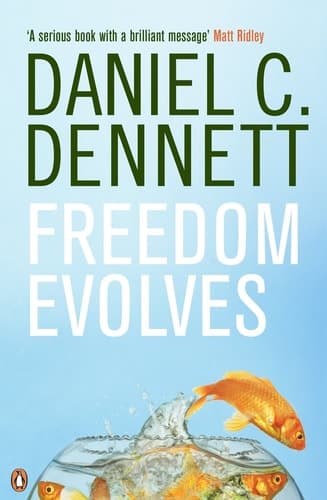
Can there be freedom and free will in a deterministic world? Renowned philosopher Daniel Dennett emphatically answers “yes!” Using an array of provocative formulations, Dennett sets out to show how we alone among the animals have evolved minds that give us free will and morality. Weaving a richly detailed narrative, Dennett explains in a series of strikingly original
arguments—drawing upon evolutionary biology, cognitive neuroscience, economics, and philosophy—that far from being an enemy of traditional explorations of freedom, morality, and meaning, the evolutionary perspective can be an indispensable ally. In Freedom Evolves, Dennett seeks to place ethics on the foundation it deserves: a realistic, naturalistic, potentially unified vision of our place in nature.
Recommendations
Generating recommendations…
Our AI is preparing recommendations for Freedom Evolves. This usually takes under a minute.
About Daniel C. Dennett
D
Daniel C. Dennett
1942–2024
Daniel Clement Dennett III was an American philosopher, writer, and cognitive scientist whose research centered on the philosophy of mind, philosophy of science, and philosophy of biology, particularly as those fields relate to evolutionary biology and cognitive science. Dennett was the co-director of the Center for Cognitive Studies and the Austin B. Fletcher Professor of Philosophy at Tufts University in Massachusetts. Dennett was a vocal atheist and secularist, a member of the Secular Coalition for America advisory board, and a member of the Committee for Skeptical Inquiry, as well as an outspoken supporter of the Brights movement. Dennett was referred to as one of the "Four Horsemen of New Atheism", along with Richard Dawkins, Sam Harris, and the late Christopher Hitchens. In 1962, Dennett married Susan Bell. They lived in North Andover, Massachusetts, and had a daughter, a son, and six grandchildren. He was an avid sailor. Dennett died of interstitial lung disease at Maine Medical Center on April 19, 2024, at the age of 82. [source: Wikipedia]
View author page