Synopsis
Have you ever had an itch and not scratched it? In the Buddhist tradition, this points to a vast paradox: that by refraining from our urge to scratch, great peace and happiness is available.
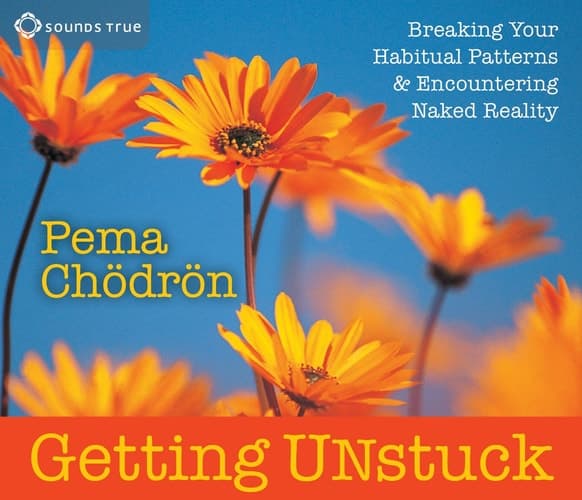
On Getting Unstuck, Pema Chödrön introduces a rare Tibetan teaching she received from her teacher, Dzigar Kontrul Rinpoche, and one that has become critical to her practice. Here, she unveils the mystery of an ineffable quality: a pre-emotional feeling that arises in us, brings us discomfort, and causes us to react by escaping the discomfort often with harmful habits.
With Getting Unstuck, she offers us a first look at both the itch and the scratch, which Tibetan Buddhists call shenpa. On this full-length recording, Pema Chödrön, bestselling author and beloved American Buddhist nun, shows us how to recognize shenpa, catch it as it appears, and develop a playful, lively curiosity toward it. Join Pema Chödrön to discover more about:
Critical mind―how to recognize this fundamental shenpa, and approach yourself and others with a sense of humor and loving-kindness
• Ways to unravel the patterns of self-denigration, and develop the fundamental maitri―loving-kindness―toward yourself
• How to cultivate acceptance of your irritability, insecurities, and other simply human traits
• Recognition, Refrain, Relaxing, and Resolve: the four R's of working with shenpa, and more
An urge comes up, we succumb to it, and it becomes stronger, teaches Pema Chödrön. We reinforce our cravings, habits, and addictions by giving in to them repeatedly. On Getting Unstuck, Chödrön guides us through this sticky feeling, exploring the moments when we get hooked, and offers us tools for learning to stay with our uneasiness, soften our hearts toward ourselves and others, and live a more peaceful life in the fullness of the present moment.
Recommendations

The Courage to Be Jewish and the Wife of an Arab Sheik
by Anne Hart
Like Chödrön, this book uses dialogue between a philosopher and a skeptic to dismantle the habits of self-blame and victimhood—but it does so through Adlerian psychology rather than Buddhism. You'll recognize the same gentle insistence that we have more agency over our suffering than we realize, just approached from a completely different cultural and philosophical tradition.
View book
The Body Keeps the Score Brain, Mind, and Body in the Healing of Trauma
by Bessel A. Van der Kolk
This is my surprise pick for you—it's neuroscience rather than spirituality, but van der Kolk explores the exact same territory Chödrön does: how our nervous system gets 'hooked' into reactive patterns, and how we can learn to recognize and interrupt them. Where Chödrön teaches you to observe shenpa with curiosity, van der Kolk shows you the biological machinery underneath that itch, which deepens the practice rather than contradicting it.
View book
The American Myth of Success From Horatio Alger to Norman Vincent Peale
by Richard Weiss
Maté takes Chödrön's insight about how we reinforce our habits and expands it into a cultural critique—showing how disconnection from ourselves and each other creates the conditions for addiction and suffering in the first place. He writes with the same compassionate directness as Chödrön, but he's asking bigger questions about why we get stuck in the first place, not just how to unstick ourselves.
View book
The Year of Magical Thinking A Play by Joan Didion Based on Her Memoir
by Joan Didion
This is a memoir about grief and the mind's desperate attempts to escape unbearable reality—which makes it a profound meditation on shenpa without ever using that word. Didion's precise, almost clinical prose as she documents her own magical thinking and denial offers a literary counterpoint to Chödrön's teachings: here's what it looks like when we scratch the itch, told by one of America's greatest writers.
View book
Publicize Your Book! An Insider's Guide to Getting Your Book the Attention it Deserves
by Jacqueline Deval
Wu traces how our attention—and our impulses—became commodified, which is a historical and economic way of exploring the same territory Chödrön maps psychologically. If you want to understand why shenpa is so powerful in modern life, Wu shows you the deliberate architecture designed to trigger it. It's Chödrön's teaching applied to the world outside your meditation cushion.
View bookAbout Pema Chödrön
Biography coming soon.
View author page