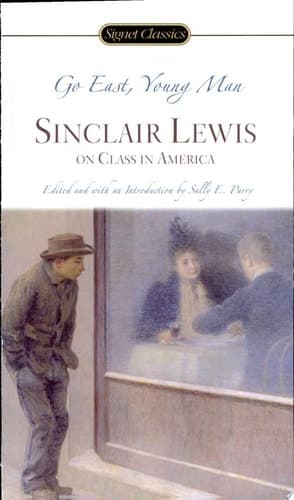
Go East, Young Man Sinclair Lewis on Class in America
Sinclair LewisPublished2005
Pages329
Formatpaperback
PublisherPenguin
Synopsis
A brand-new collection of Sinclair Lewis's prolific body of short fiction, focusing on the author's primary concerns: the issue of class, work and money in America.
Recommendations
Studies in the Financial Markets of the Pacific Basin
by Theodore Bos
Dreiser shares Lewis's unflinching eye for how money shapes character and ambition in America, but he digs deeper into the psychological cost of that pursuit. Where Lewis often uses satire to expose social climbing, Dreiser presents it as tragedy—his protagonist's ruthlessness feels inevitable rather than ridiculous, which gives the class commentary a darker weight that complements what you've just read.
View book
The remains of the day de Kazuo Ishiguro
by Gallix/François
This is my slight curveball for you, but hear me out: Ishiguro examines class and social hierarchy through the eyes of an English butler, and the way he reveals how institutional loyalty can hollow out a person's life has the same quiet devastation that Lewis achieves through satire. The unreliable narrator gradually shows us the gap between how he sees himself and what he's actually become—a meditation on work and dignity that feels like a spiritual cousin to Lewis's concerns, just filtered through restraint instead of irony.
View book
The Grapes of Wrath John Steinbeck
by John Steinbeck
Published in 1939, this gives you that different-decade perspective while staying thematically close. Steinbeck takes Lewis's interest in how economic systems fail ordinary people and makes it epic and urgent—he's less interested in satirizing the middle class and more interested in documenting the dispossessed. The Joad family's struggle shows you what happens when the class system Lewis was examining collapses entirely.
View book
Ralph Ellison - Invisible Man
by Anke Balduf
Ellison does something Lewis couldn't quite do in the 1920s-30s: he makes class inseparable from race and shows how American capitalism weaponizes invisibility. His protagonist moves through different social worlds and institutions—each one promising opportunity, each one exploitative in different ways—and the novel's bitter comedy about self-deception and social performance echoes Lewis's satirical method while expanding it into something more structurally radical.
View book
Sellout The Inside Story of President Clinton's Impeachment
by David P. Schippers
Here's your real surprise: Beatty is a contemporary writer who weaponizes absurdist humor the way Lewis did, but he's writing about race, class, and American delusion in the 21st century. The novel's narrator is a Black farmer in Los Angeles who decides to reinstitute slavery in his neighborhood as a form of protest—it sounds outrageous, but Beatty uses that grotesque premise to ask the same questions Lewis was asking about who benefits from American systems and who gets left behind. It's Lewis's satirical DNA applied to a world Lewis never imagined.
View bookAbout Sinclair Lewis
S
Sinclair Lewis
1885–1951
American novelist, short-story writer, and playwright
View author page