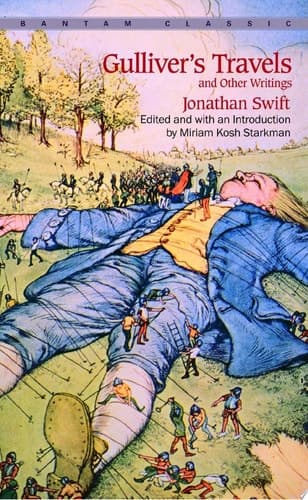
Gulliver's Travels and Other Writings
Jonathan SwiftPublished1984
Pages656
Formatpaperback
PublisherRandom House Publishing Group
Synopsis
Nominated as one of America’s best-loved novels by PBS’s The Great American Read
“It is universally read, from the cabinet council to the nursery,” remarked Alexander Pope when Gulliver's Travels was published in 1726. One of the unique books of world literature, Swift's masterful satire describes the astonishing voyages of one Lemuel Gulliver, a ship's surgeon, to surreal kingdoms inhabited by miniature people and giants, quack philosophers and scientists, horses endowed with reason and men who behave like beasts. Written with great wit and invention, Gulliver's Travels is a savage parody on man and his institutions that has captivated readers for nearly three centuries.
As bestselling author and critic Allan Bloom observed: “Gulliver's Travels is an amazing rhetorical achievement. Swift had not only the judgment with which to arrive at a reasoned view of the world but the fancy by means of which he could re-create that world in a form which teaches where argument fails and which satisfies all while misleading none.”
This representative collection of Swift’s major writings includes the complete Gulliver’s Travels as well as A Tale of a Tub, “The Battle of the Books,” “A Modest Proposal,” “An Argument Against Abolishing Christianity,” “The Bickerstaff Papers,” and many more of his brilliantly satirical works. Here too are selections from Swift’s poetry and portions of his Journal to Stella. Swift’s savage ridicule, corrosive wit, and sparkling humor are fully displayed in this comprehensive collection.
Recommendations

Voltaire: Candide
by Voltaire
Voltaire shares Swift's gift for using absurd journeys to eviscerate philosophical pretension—where Swift's Gulliver encounters ridiculous kingdoms, Candide stumbles through a world of relentless misfortune that systematically demolishes his tutor's optimism. Both authors wield satire as a scalpel rather than a club, letting the ridiculousness of their worlds do the intellectual work that heavy-handed argument never could.
View book
The Apocalyptic Vision of Mikhail Bulgakov's the Master and Margarita (Studies in Slavic Language & Literature)
by Edward E. Ericson
This 1960s Soviet novel has Swift's same fearless willingness to mock institutional power through fantastical displacement—instead of tiny kingdoms, Bulgakov gives us the Devil visiting Moscow, but the satirical target (bureaucratic absurdity, literary gatekeeping, ideological rigidity) is just as sharp. The narrative structure mirrors Swift's multiple perspectives, letting you see the same ridiculous world from radically different angles.
View book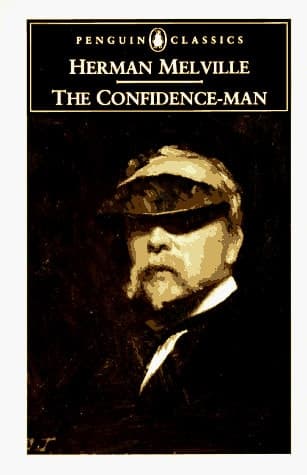
The Confidence-Man His Masquerade
by Herman Melville
Melville channels Swift's misanthropic wit through an American riverboat where every passenger is either a con artist or a mark—the novel reads like Gulliver's Travels if Gulliver himself were the problem rather than the observer. The dialogue crackles with the same corrosive intelligence, and Melville's refusal to let readers feel morally superior to his characters echoes Swift's savage view of human nature.
View book
Find what the Sailor Has Hidden Vladimir Nabokov's Pale Fire
by Priscilla Meyer
Here's your surprise pick: this is technically a poem with a scholarly apparatus, but it's really Swift's game of making readers complicit in absurdity through unreliable narration. The editor's footnotes gradually reveal he's either delusional or a murderer, and you're trapped in his interpretive world—it has the same vertigo-inducing quality as realizing Gulliver might be the unreliable narrator of his own travels.
View book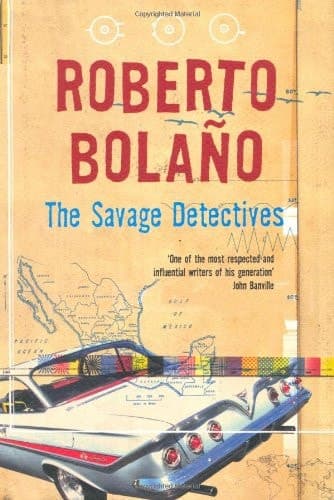
The Savage Detectives A Novel
by Roberto Bolaño
Bolaño's sprawling novel treats literary pretension and bohemian self-delusion with the same withering eye Swift turned on philosophers and scientists—except here the 'kingdoms' are poetry movements and the 'voyages' are the picaresque wanderings of failed intellectuals across Latin America. Like Swift, Bolaño never quite lets you know if he's mocking his characters or mourning them, which makes the satire cut deeper.
View bookAbout Jonathan Swift
J
Jonathan Swift
1667–1745
Jonathan Swift was an Irish satirist, essayist, political pamphleteer (first for the Whigs, then for the Tories), poet and cleric who became Dean of St. Patrick's, Dublin. He is remembered for works such as Gulliver's Travels, A Modest Proposal, A Journal to Stella, Drapier's Letters, The Battle of the Books, An Argument Against Abolishing Christianity, and A Tale of a Tub. Source and more information: https://en.wikipedia.org/wiki/Jonathan_Swift
View author page