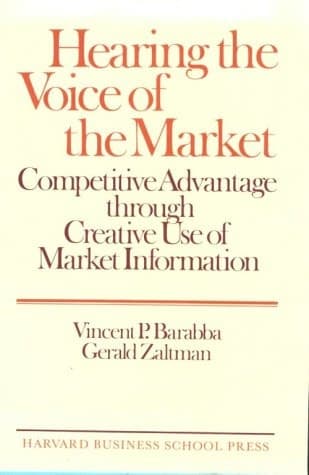
Hearing the Voice of the Market Competitive Advantage Through Creative Use of Market Information
Vincent P. BarabbaPublished1991
Pages294
Formathardcover
PublisherHarvard Business School Press
Synopsis
Hearing the Voice of the Market provides a detailed plan that enables managers throughout the organization to make more frequent & better use of market information. The book shows managers how to develop the two capabilities that distinguish the successful, market-oriented firm--competent curiosity, & competent knowledge use. The two are closely linked: inadequate information cannot be used well, & sound information is wasted if it is utilized poorly. Includes experiences & insights of the many managers & researchers cited in the text. Readers will learn how to create an environment in which managers are inquisitive about their markets, are able to satisfy their curiosity with real market information, & can make knowledge-based decisions that lead to success. This book provides guidance on how managers may make better use of market information. It argues that market research on its own is not enough, and that an intelligent system of interpreting and using market research information is required.
Recommendations

The Innovator's Dilemma: When New Technologies Cause Great Firms To Fail
by Clayton M. Christensen
Christensen shares Barabba's conviction that market information alone won't save you—it's how you *interpret* it that matters. He shows how successful companies can misread market signals precisely because their existing knowledge frameworks blind them to disruptive threats, which directly extends Barabba's argument about the need for intelligent systems of interpretation rather than raw data collection.
View book
Competing Against America: Why Canada Has Fallen Behind in the Race for Talent and Wealth (And What To Do About It)
by Michael Alexander
Wait—I know I just recommended Christensen, but this is a different book that pivots his thinking toward what Barabba calls 'competent curiosity.' Rather than asking what customers want, Christensen explores what job customers are actually trying to accomplish, which reframes how you should listen to market voices and what questions you should ask.
View book
Seductress of Sight: Studies in Dutch Art of the Golden Age (Studies in Netherlandish Art and Cultural History)
by Eric Jan Sluijter
Mahajan teaches you how to extract meaning from information—exactly what Barabba means by 'competent knowledge use.' He shows managers how to think clearly about complex systems using approximation and intuition alongside data, which is the missing piece between collecting market information and actually using it wisely.
View book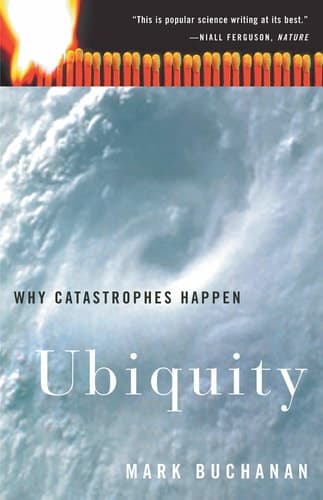
Ubiquity Why Catastrophes Happen
by Mark Buchanan
This is your surprise recommendation: a philosophical business book that challenges the very premise of 'hearing the voice of the market' by arguing that direct pursuit of market information often fails. Kay suggests that successful firms sometimes succeed *despite* not optimizing for what markets tell them, which offers a necessary counterargument to Barabba's framework and will make you think harder about when to listen and when to trust instinct.
View book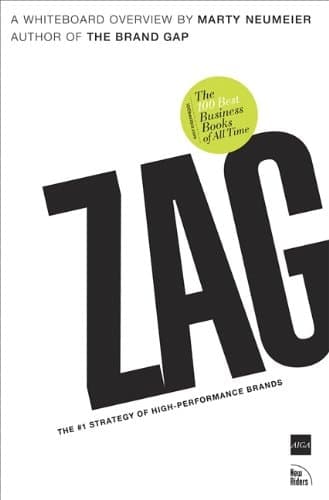
Zag The Number-one Strategy of High-performance Brands : a Whiteboard Overview
by Marty Neumeier
Neumeier argues that truly successful brands don't follow market information—they create it by doing the opposite of what the market expects. It's a practical counterpoint to Barabba's market-listening approach, showing how 'competent curiosity' sometimes means asking what the market *doesn't* know it wants yet, rather than simply responding to current signals.
View bookAbout Vincent P. Barabba
Biography coming soon.
View author page