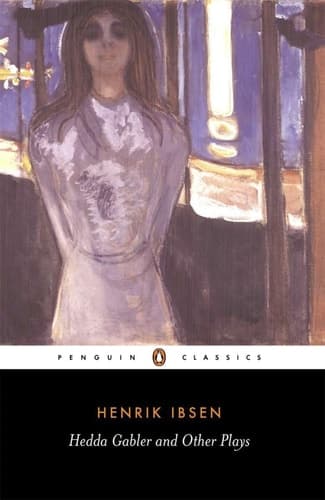
Hedda Gabler and Other Plays
Henrik IbsenPublished1961
Pages368
Formatpaperback
PublisherPenguin Books Limited
Synopsis
In these three unforgettably intense plays, Henrik Ibsen explores the problems of personal and social morality that he perceived in the world around him and, in particular, the complex nature of truth. The Pillars of the Community (1877) depicts a corrupt shipowner’s struggle to hide the sins of his past at the expense of another man’s reputation, while in The Wild Duck (1884) an idealist, believing he must tell the truth at any cost, destroys a family by exposing the lie behind his friend’s marriage. And Hedda Gabler (1890) portrays an unhappily married woman who is unable to break free from the conventional life she has created for herself, with tragic results for the entire family.
Recommendations
Generating recommendations…
Our AI is preparing recommendations for Hedda Gabler and Other Plays. This usually takes under a minute.
About Henrik Ibsen
H
Henrik Ibsen
1828–1906
Henrik Ibsen was a major 19th-century Norwegian playwright, theatre director, and poet. He is often referred to as "the god father" of modern drama and is one of the founders of Modernism in the theatre.[1] His plays were considered scandalous to many of his era, when Victorian values of family life and propriety largely held sway in Europe. Ibsen's work examined the realities that lay behind many facades, possessing a revelatory nature that was disquieting to many contemporaries. It utilized a critical eye and free inquiry into the conditions of life and issues of morality. Ibsen is often ranked as one of the truly great playwrights in the European tradition, alongside Shakespeare. <cite>— [Wikipedia](https://en.wikipedia.org/wiki/Henrik_Ibsen)</cite>
View author page